
Lip Balm Flavour Oils vs Food Flavour Oils: Food-Grade Rules, FSSAI, Lip-Safe Flavours and Sweeteners
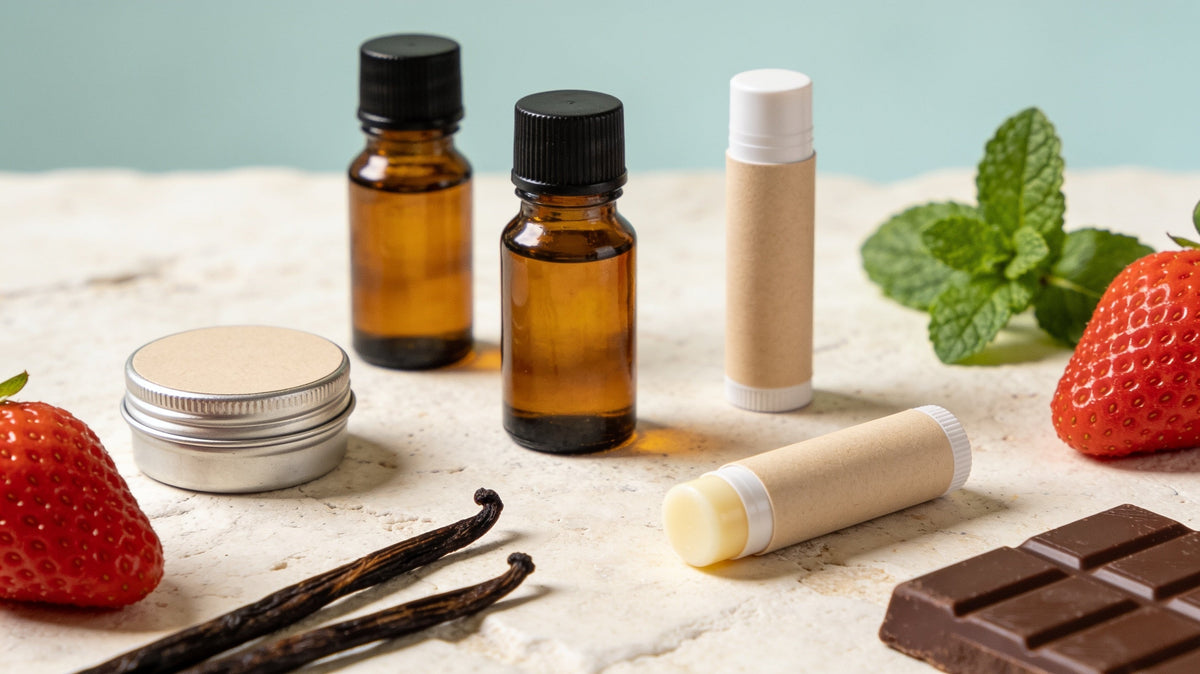
Lip balm flavour oils are cosmetic ingredients for lip products, while food flavour oils are food ingredients that must meet food law, in India under FSSAI. They are not interchangeable without checking documentation for the intended use. Dose both according to supplier guidance and test in your own base.
Lip balm flavour oils are cosmetic ingredients designed to taste and smell pleasant in lip products, usually oil-soluble and assessed under cosmetic rules. Food flavour oils are food ingredients that must meet food law, in India under FSSAI. Use a lip-safe flavour for lip care and a food-grade flavour from a licensed supplier for anything that is eaten.
Flavour is one of the few areas where cosmetic and food regulation sit side by side, and buyers sometimes assume one product can serve both. It can occasionally, but only when the documentation supports both uses. As a cosmetic raw materials manufacturer in India, we make lip balm flavour oils for cosmetics and food flavour oils supplied as food-grade under our FSSAI licence. This guide explains how they differ and what to check before you buy.
The core difference
| Aspect | Lip balm flavour oil | Food flavour oil |
|---|---|---|
| Regulatory frame | Cosmetic rules in the market of sale | Food law in the market of sale (FSSAI in India) |
| Intended use | Lip balms, glosses, tinted lip care | Confectionery, bakery, beverages and other foods |
| Typical carrier | Oil-soluble, to disperse in waxes and butters | Oil- or water-soluble, depending on the food application |
| Key documents | COA, SDS, and allergen or IFRA information where fragrance materials are present | COA, food-grade status and supplier licence details |
| On the finished label | Declared in the cosmetic ingredient list, often as flavour or aroma | Declared under food labelling rules for flavourings |
Food-grade requirements in India
In India, food and food ingredients are regulated by the Food Safety and Standards Authority of India (FSSAI) under the Food Safety and Standards Act, 2006 and its regulations. In general terms, that means:
- The manufacturer must be licensed or registered with FSSAI for the relevant activity. Harrods Health is FSSAI licensed for food-grade flavours and nutraceuticals.
- Flavourings are categorised broadly as natural, nature-identical or artificial flavouring substances, and food labels must declare added flavour in the prescribed way.
- Only permitted substances may be used, within any limits set for the food category.
- Food businesses buying flavours should source from licensed suppliers and keep traceability records.
If you export food products, the destination's food law applies as well, such as the EU flavourings regulation or US food labelling rules. Confirm requirements with your importer or a regulatory specialist before launch, because permitted substances and label wording differ between markets.

What makes a flavour lip-safe
Lip products are cosmetics, but they are applied to a sensitive area and a small amount is inevitably swallowed during use. A flavour suitable for lip care should therefore:
- Be made from materials acceptable for lip application and free from substances restricted for that use.
- Comply with IFRA standards for lip products where it contains fragrance materials. IFRA treats lip products as a separate category with some of the tightest limits.
- Be oil-soluble so it disperses evenly through waxes, butters and oils without separating or sweating out.
- Avoid harsh irritants at high levels. Some warm spice and cooling notes contain known sensitisers or produce a tingle that customers may not expect.
- Come with documentation such as COA and SDS, plus allergen information where your market requires it.
A food flavour is not automatically lip-safe, because food rules do not address skin sensitisation or IFRA categories. Equally, a lip balm flavour is not a food ingredient and must never be used in food.
Dosage: follow supplier guidance
We do not publish universal use levels, and you should be wary of anyone who does. Flavour strength varies widely between products, IFRA limits for lip products can be lower than you would expect, and the base itself changes perception: a firm beeswax stick releases flavour differently from a soft gloss. Follow the supplier's guidance for each flavour, start trial batches at the lower end of the recommended range, and assess in the finished product after it has set and rested. Keep a record of the level that worked so production can repeat it.
Sweeteners in lip products
Customers expect fruit and dessert flavours to taste sweet, but ordinary sugar does not dissolve in oils and waxes and leaves a gritty texture. Lip products therefore use sweeteners suitable for cosmetics, such as sodium saccharin, sucralose or stevia-derived ingredients, often in oil-dispersible forms. Some lip flavours are supplied pre-sweetened; if so, the sweetener must appear on your ingredient list.
In foods, sweeteners are regulated separately as food additives, with permitted food categories and limits. Do not assume a sweetener permitted in one context is permitted in the other.
Handling both ranges in one facility
If your business makes both cosmetics and food, keep the two flavour ranges physically separate, labelled clearly and logged in separate stock records. Mix-ups are rare but serious, and auditors look for this separation. Brands that make lip balms alongside other handmade products can read our guide to raw materials for soap, candles and lip balms.
Common mistakes with flavour oils
- Using candle or soap fragrance in lip balm. These are formulated for different IFRA categories and are not designed for lip contact.
- Assuming "food-grade" means "lip-safe". Food status says nothing about skin sensitisation or IFRA compliance for lip products.
- Using water-soluble flavours in anhydrous balms. They separate, bead on the surface or create weak spots in the stick.
- Adding flavour to very hot wax. Some flavour components are volatile and can flash off, weakening the result; follow supplier guidance on addition temperature.
- Forgetting the ingredient list. Flavour, sweetener and any allergens must be declared in the format your market requires.
- Changing flavour supplier without retesting. Two strawberry flavours can differ greatly in strength, colour and stability.
Documentation checklist
- For lip balm flavours: COA, SDS, allergen information where required, IFRA conformity for the lip category where fragrance materials are present, and confirmation of any sweetener.
- For food flavours: COA, confirmation of food-grade status, the supplier's FSSAI licence details, and the flavour category for your label.
- For exports: destination-specific statements agreed with your importer, plus transport classification where the flavour is flammable.
Our licences and certifications are listed on the quality and certifications page. For lip-safe ranges, see our lip balm flavour oils.
Frequently asked questions
Can I use a food flavour oil in lip balm?
Only if the supplier confirms it is suitable for cosmetic lip use and provides the documentation your cosmetic file needs, such as allergen and IFRA information where relevant. Food-grade status alone does not make a flavour lip-safe.
Can I use a lip balm flavour oil in food?
No. Lip balm flavour oils are cosmetic ingredients. Foods must use food-grade flavours from a supplier licensed under food law, which in India means FSSAI.
How much flavour oil should I add to lip balm?
Follow the supplier's guidance for that specific flavour, because strength and IFRA limits vary. Start trial batches at the low end of the recommended range and assess after the balm has set.
How do I make lip balm taste sweet?
Use a sweetener suitable for cosmetics, such as sodium saccharin, sucralose or a stevia-derived ingredient, in an oil-dispersible form, or choose a pre-sweetened lip flavour. List the sweetener on your ingredient label.
Sourcing for confectionery or bakery? See our food flavour oils, supplied as food-grade under our FSSAI licence.
Related service: Raw materials manufacturing and supply →
Tell us your idea. An account manager replies within 1 business day.
More from Harrods Insights
Keep reading

Shipping Hotel Amenities from India to China and Hong Kong: Consignee, Broker, Customs Inspection, Documents and Seasonal Planning

Supplying Hotels in Hong Kong and Macau: How the Rules Differ from the Mainland, Safety and Trade Descriptions Law, Labelling and Practical Buying
