
Private Label vs Custom Formula for Pet Brands
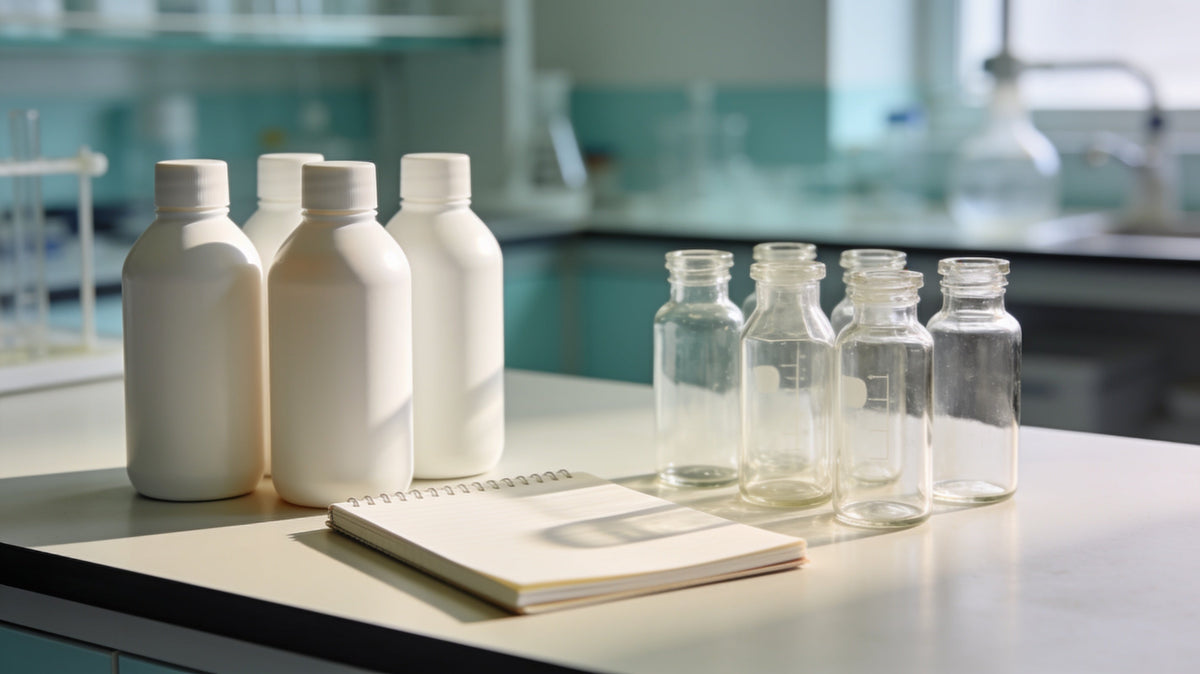
Private label puts your brand on a proven ready formula with your own fragrance, colour and packaging, from 500 units per product. Custom formula is developed to your brief and suits brands with a specific gap. Many brands launch on private label and develop a custom hero product later.
Private label means putting your brand on a proven ready formula, with your own fragrance, colour and packaging; custom formula means developing a product specifically for you. Private label is faster and needs a smaller first order, while custom suits brands with a clear, specific gap to fill.
Almost every pet brand faces this choice, and it is rarely all-or-nothing. Many successful brands launch with private label products and add custom formulas as they grow. This guide compares the two routes so you can decide which suits each product in your range. For an overview of both options, see our pet care third-party manufacturing page.
What private label means in pet care
Private label, sometimes called white label, uses a formula the manufacturer has already developed and produced. You choose from a range of ready bases, such as shampoos, conditioners, sprays and balms, and make it your own through:
- product name and brand identity;
- fragrance, either from a standard library or a custom fragrance;
- colour, where the formula allows;
- bottle, closure and decoration;
- pack sizes and sets.
Because the base has already been developed and made before, there is less uncertainty in production, and samples are available quickly. Our ready formulas start from 500 units per product. See our ready-to-market page for how this works.
What custom formula means
A custom formula is developed to your brief. You might want a particular texture, a specific botanical story, a concentrated groomer shampoo with a set dilution, a vegan wax system in a balm or a formula without certain ingredient groups. The manufacturer's formulation team develops options, you test them, adjustments are made, and the chosen formula is checked for stability and compatibility with its packaging before production.
Our custom formulation page explains the process in more detail.

Side-by-side comparison
| Factor | Private label (ready formula) | Custom formula |
|---|---|---|
| Time to market | Shorter, as development is already done | Longer, with development, sampling rounds and stability checks |
| First order size | Lower, from 500 units per product | Usually higher, depending on the brief |
| Upfront investment | Lower | Higher, including development and trial batches |
| Product differentiation | Through fragrance, colour, name and packaging | Through the formula itself, plus all of the above |
| Risk | Lower, as the base is proven in production | Higher, as new formulas need testing and refinement |
| Control | Choose from defined options | Shape the product to your exact brief |
| Best for | New brands, pet shops, groomers, testing demand | Established brands, specific gaps, signature hero products |
When private label is the right choice
- You are launching your first range. Spend your early budget on marketing and stock rather than development.
- You are a pet shop, groomer or vet's retail counter. Your customers trust you; a well-presented own-brand range is often all you need.
- You want to test demand. Launch quickly, learn which scents and formats sell, then invest.
- You need several formats at once. A complete starter range of shampoo, spray and balm is much easier with ready bases.
- Your timeline is tight. For example, a seasonal launch or a marketplace event.
When a custom formula makes sense
- You have a clear, specific gap. For example, a very light leave-in spray for a particular coat type or a fragrance-free cat range with an especially short ingredient list.
- Your brand story depends on the formula. If you are built around a particular ingredient or philosophy, a custom formula makes the story real.
- You serve professionals. Groomers may want a concentrated shampoo with a specific dilution and rinse profile.
- You are scaling. Once a product sells well, a custom version can help protect your position and improve the product.
- Your export market has specific ingredient expectations. Some buyers prefer or exclude certain ingredient groups.
The hybrid approach most brands use
You do not have to choose one route for the whole brand. A common path is:
- Launch with ready formulas across three to six products, using your own fragrance, colour and packaging.
- Gather sales data and customer feedback for several months.
- Identify your best seller or a clear gap your customers mention.
- Develop a custom formula for that hero product while the rest of the range stays on ready bases.
This keeps cash flow healthy and focuses development money where it will make the most difference. If you are still planning the range, our pet brand manufacturing checklist walks through each step.
Common misconceptions
"Private label products are all the same"
The base may be shared, but fragrance, colour, name, packaging, pack size and how you present the product all shape what customers experience. Two brands on similar bases can feel entirely different on the shelf.
"Custom means better"
Not automatically. A custom formula is only better if it solves a real need for your customer. A proven ready formula that performs well is often the stronger choice for a new brand.
"Custom lets me make stronger claims"
Claims are governed by regulation, not by whether a formula is custom. Grooming products should stick to grooming language such as "cleanses", "conditions", "freshens" and "detangles". Claims about parasites or treating conditions move a product into separately regulated categories. Our guide to labelling pet grooming products explains more.
Thinking about cost and cash flow
For a young brand, cash flow often matters more than unit cost. A custom formula may eventually lower your cost per unit or lift your price, but it asks for money upfront and a larger first order before you have sales data. Private label lets you spread risk across several products in smaller runs and reorder what sells. When you compare quotes, look at the total cash needed to reach shelf, including development, samples, packaging minimums, first production and shipping, not just the price per bottle. It is also worth asking how reorders are handled, since a smooth second and third order is where a manufacturing relationship really proves its value.
Questions to settle before you decide
- What is my budget for development, stock and marketing combined?
- When do I need products on shelf or online?
- How many products and variants do I need at launch?
- What will make customers choose my product over others: the formula, the scent, the look or the price?
- Do I have evidence that a custom formula would sell better?
Whichever route you choose, the same facility standards apply. Our facility is ISO certified, a GMP-compliant facility, Halal certified, holds an AYUSH licence, is a US FDA registered facility and holds a state FDA cosmetic manufacturing licence. A single account manager coordinates your project, and we provide samples before any order. Our MOQ and pricing page explains how minimums work for each route.
Frequently asked questions
Can I change fragrance and colour on a private label pet shampoo?
Yes. Ready formulas can be supplied with a custom fragrance, colour and packaging, so the product feels like your own brand.
Do I own a custom formula?
Ownership and exclusivity terms vary, so agree them in writing before development starts, including what happens if you move production.
Is it possible to start private label and switch to custom later?
Yes, and many brands do exactly that, keeping most of the range on ready formulas and developing a custom version of their best seller.
Which route is cheaper?
Private label usually costs less upfront because development is already done and minimum orders are lower, starting from 500 units per product.
Not sure which route suits you? Talk to our pet care third-party manufacturing team.
Related service: Pet grooming third-party manufacturing →
Tell us your idea. An account manager replies within 1 business day.
More from Harrods Insights
Keep reading

Shipping Hotel Amenities from India to China and Hong Kong: Consignee, Broker, Customs Inspection, Documents and Seasonal Planning

Supplying Hotels in Hong Kong and Macau: How the Rules Differ from the Mainland, Safety and Trade Descriptions Law, Labelling and Practical Buying
