
Exporting Massage and Body Oils from India: Documents, Labelling, Stability and Packaging
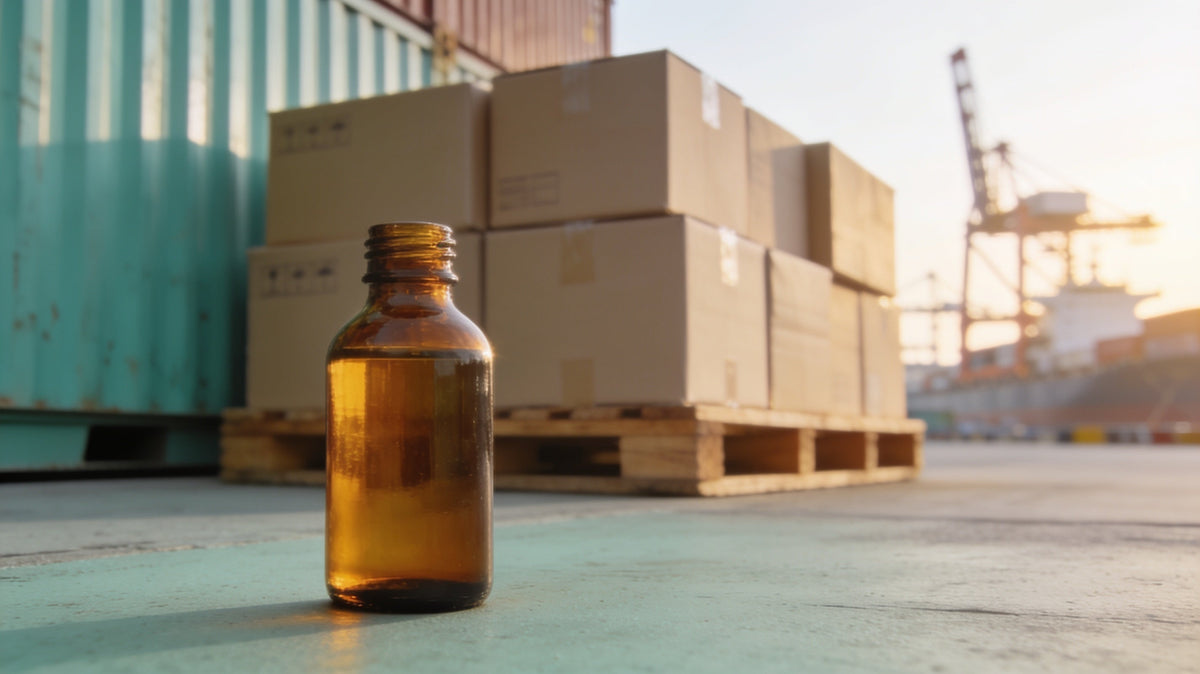
Exporting massage and body oils from India needs two sets of paperwork: shipping documents such as the commercial invoice, packing list and certificate of origin, and destination-market compliance such as a responsible person, safety assessment and correct labelling. Oils must also survive heat, cold and pressure changes in transit, so stability checks and leak-proof closures matter. Agreeing destination rules before artwork and packaging saves the most time.
To export massage and body oils from India you need shipping documents (commercial invoice, packing list, certificate of origin, transport document and supporting product data) plus destination-market compliance such as a local responsible person, safety assessment and correct labels. Stability checks and leak-proof packaging protect the oil on the journey.
Importers and brand owners in the UAE, the UK, Europe, the United States, Australia and South-East Asia often ask what is involved before the first container or air shipment leaves. A massage oil manufacturer in India that exports regularly will prepare most of the manufacturing-side paperwork, but some steps sit with you or your importer. This guide sets out who does what.
Shipping documents from India
A typical export consignment of cosmetic oils travels with:
- Commercial invoice showing buyer, seller, product description, quantities, values, Incoterms and HS classification.
- Packing list detailing cartons, net and gross weights, dimensions and batch numbers.
- Shipping bill filed with Indian customs for export clearance.
- Bill of lading or air waybill issued by the carrier.
- Certificate of origin, including a preferential certificate where a trade agreement between India and the destination applies and the product qualifies.
- Certificate of analysis for each batch.
- Safety data sheet describing physical properties and transport classification.
Depending on the destination and buyer, you may also be asked for a free sale certificate, manufacturing licence copies, a GMP certificate or a Halal certificate. Our facility is ISO certified, a GMP-compliant facility, Halal certified, holds an AYUSH licence, is a US FDA registered facility and holds a state FDA cosmetic manufacturing licence; copies and details are on our quality and certifications page. Formulas are dermatologically tested and test reports are available on request.
Our fulfilment and export service covers packing, documents and dispatch to warehouses, marketplaces or export ports, with a single account manager coordinating the paperwork.
Destination-market compliance at a glance
Manufacturing paperwork from India does not by itself make a product legal to sell abroad. Each market has its own cosmetic rules. The table below is a simplified overview; always confirm current requirements with your importer or regulatory adviser.
| Market | Key requirements | Label essentials |
|---|---|---|
| European Union | EU-based responsible person, product information file, cosmetic product safety report, notification on the EU cosmetic portal | Function, responsible person's name and address, nominal content, durability date or period-after-opening, precautions, batch, ingredient list, country of origin, local language |
| United Kingdom | UK-based responsible person, safety assessment, product information file, notification on the UK cosmetic portal | As EU, with UK responsible person's address |
| United States | Facility registration and product listing under current cosmetic law, safety substantiation, adverse event handling | Statement of identity, net quantity in metric and US units, ingredients in descending order, name and place of business, warnings, country of origin |
| GCC (UAE, Saudi Arabia and others) | Product registration or listing through national systems, often via a local importer | Arabic text alongside English, ingredients, batch, manufacturing and expiry dates, origin |
| Australia | Importer registration for the chemicals in cosmetics, compliance with cosmetic ingredient labelling rules | Ingredient list, net quantity, supplier details, country of origin |
Labelling tips that save reprints
- Confirm destination markets before artwork starts, so one label can cover several countries where possible.
- Use INCI names in the ingredient list and declare fragrance allergens above the thresholds set in each market.
- Keep claims cosmetic: moisturises, softens, glides and helps skin feel relaxed. Therapeutic claims can change a product's legal category.
- Reserve space for the importer or responsible person's address and for translations.
- Print batch numbers and dates in a way that survives oil contact, such as laser coding or oil-resistant ink.
If your oil is positioned as Ayurvedic, read our guide on Ayurvedic massage oils for export, since medicinal and cosmetic routes differ.

Stability for long journeys
A sea shipment can sit in a hot container at port, cross the equator and arrive in a cold warehouse. Oils respond to these conditions in predictable ways:
- Heat speeds up oxidation, which can change odour and colour.
- Cold can make some oils cloudy or partly solid; coconut-based oils may solidify and then clear again when warmed.
- Light exposure during storage can fade colour and degrade fragrance.
Before export, formulas should go through stability checks covering elevated and low temperatures and temperature cycling in the final pack. Antioxidants, amber or opaque packs and cartons all add protection. Ask your importer about storage conditions at their warehouse, too, because the journey does not end at the port.
Leak-proof packaging for export
Oil finds its way through any weak seal, and one leaking bottle can spoil a whole carton of labels. Good export packaging uses:
- Closures tested with oil and fitted to the correct torque.
- Induction seals or inner wads under caps, and lockable pumps or pump clips.
- Shrink bands or tamper seals where appropriate.
- Oil-resistant label stock and adhesives.
- Inner polybags or dividers in cartons, and strong outer cartons rated for stacking.
- Headspace in bottles for air freight, where pressure changes can push oil past seals.
Our custom packaging service helps select bottles, closures and shipper cartons that suit your route, whether by sea or air.
Transport classification
Many carrier-oil-based massage and body oils are not classed as dangerous goods for transport, but this is not automatic. Products with high levels of essential oils or alcohol, and aerosol formats, may be classified differently because of flash point or pressure. The safety data sheet should state the transport classification, and your freight forwarder will confirm how the consignment must be declared.
Samples and approvals before shipping
Before the first commercial shipment, send approved samples to your importer or responsible person so they can check the label, the pack and the documents against local rules. Samples are provided before any order, and the approved reference unit becomes the standard each export batch is checked against. Shipping a small pilot quantity first can also reveal practical issues, such as carton strength or closure performance on your actual route, before you commit to a full container.
A simple export checklist
- Confirm destination markets, product category and responsible person or importer.
- Agree formula, claims and label content for those markets.
- Complete stability checks in the final pack.
- Approve packaging, closures and shipper cartons.
- Collect certificates of analysis, safety data sheets and any certificates the buyer needs.
- Agree Incoterms, freight mode and delivery address.
- Register or notify the product in the destination market before it is placed on sale.
Frequently asked questions
What documents are needed to export cosmetic oils from India?
Typically a commercial invoice, packing list, shipping bill, bill of lading or air waybill, certificate of origin, certificate of analysis and safety data sheet. Some buyers also request a free sale, GMP or Halal certificate.
Who is responsible for EU or UK compliance?
An EU- or UK-based responsible person must hold the product information file, safety report and notification. This is usually the brand owner, importer or an appointed service provider, not the Indian manufacturer.
Are massage oils dangerous goods for shipping?
Many carrier-oil products are not, but essential-oil-rich, alcohol-containing or aerosol formats may be. The safety data sheet states the transport classification and your forwarder confirms the declaration.
How do I stop massage oil bottles leaking in transit?
Use oil-tested closures at the correct torque, induction seals or inner wads, lockable pumps, oil-resistant labels, inner polybags and strong outer cartons.
Planning an export launch? Speak to our massage oil manufacturing and export team.
Related service: Massage oil manufacturing for your brand →
Tell us your idea. An account manager replies within 1 business day.
More from Harrods Insights
Keep reading
Shipping Hotel Amenities from India to China and Hong Kong: Consignee, Broker, Customs Inspection, Documents and Seasonal Planning

Supplying Hotels in Hong Kong and Macau: How the Rules Differ from the Mainland, Safety and Trade Descriptions Law, Labelling and Practical Buying
