
Essential Oil Manufacturing in India: Steam Distillation, Cold Pressing and How to Read a COA and GC-MS Report
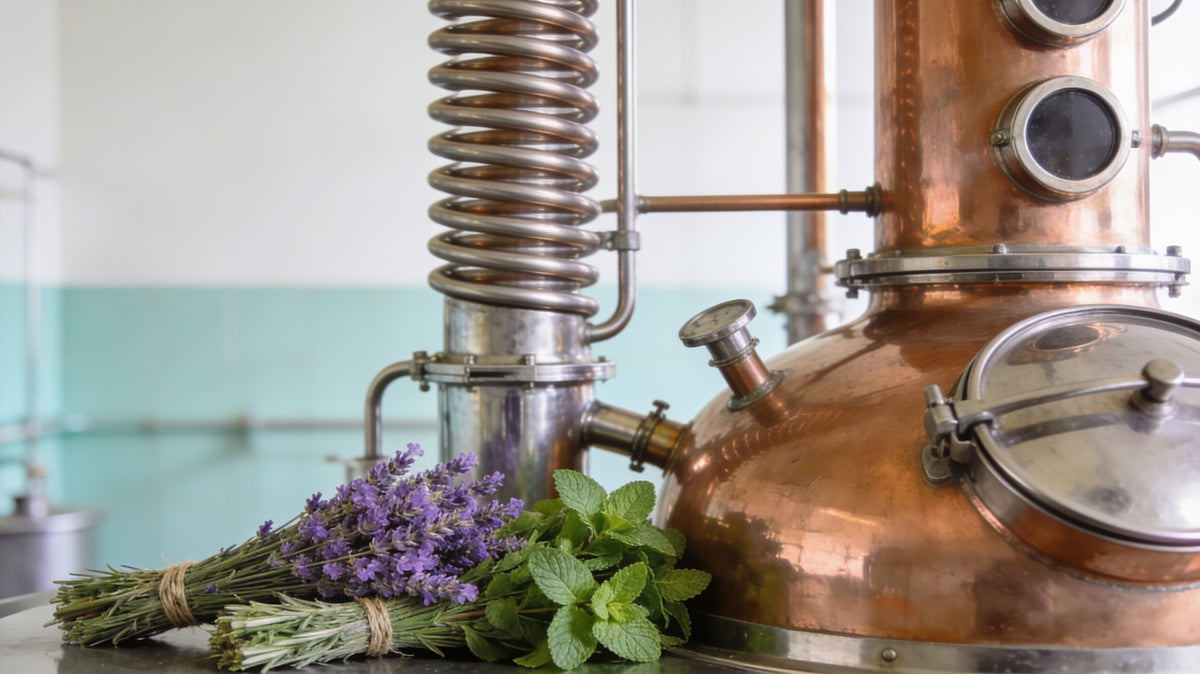
Most essential oils are produced by steam distillation, while citrus peel oils are usually cold pressed. Buyers judge quality from physical constants on the COA and from the constituent profile in a GC or GC-MS report. Specifications use ranges because natural oils vary between harvests.
Essential oils are made mainly by steam distillation of plant material, or by cold pressing (expression) of citrus peel. Quality is judged on the Certificate of Analysis, through physical constants such as specific gravity, refractive index and optical rotation, and on the gas chromatography (GC or GC-MS) profile, which shows the oil's main constituents against an expected range.
For a buyer, the production method matters because it shapes odour, colour, stability and the documents you should expect. This guide is written from the perspective of an essential oil manufacturer in India that distils in-house. It covers how oils are produced, which quality markers are worth checking, and how to read the two documents that matter most when you approve a batch.
How essential oils are produced
Steam distillation
In steam distillation, steam passes through a still packed with plant material. The heat and moisture release volatile aromatic compounds, which travel with the steam into a condenser. As the vapour cools, it separates into two layers in a receiving vessel: the essential oil and the aromatic water, often called hydrosol or distillate water.
Several variables change the result: whether the material is fresh, wilted or dried, how finely it is cut, how tightly the still is packed, steam rate and pressure, and how long the run lasts. Heavier molecules tend to come over later in a distillation, so a short run and a full run of the same plant can produce noticeably different oils. A consistent process is therefore as important as consistent raw material.
Water and water-steam distillation
Some materials, particularly fine powders or those that clump together, are distilled in direct contact with boiling water, or sitting on a grid above water. The principle is the same; the gentler or harsher contact with water can change the odour profile slightly.
Cold pressing (expression)
Citrus peel oils are usually obtained by mechanically rupturing the oil glands in the peel and separating the oil from the juice and water, often by centrifuge. No distillation heat is involved, so the oil keeps a fresh, true-to-fruit character. Expressed citrus oils also carry non-volatile components that distilled oils do not, including, in some oils, furocoumarins linked to phototoxicity. That is why the same citrus can carry different use limits in leave-on skin products depending on whether it was pressed or distilled.
Rectification and fractionation
An oil can be redistilled to remove unwanted components or to adjust its profile. This is a legitimate process, but a rectified or fractionated oil is a different product from the crude oil and should be described as such on documents.
What is not an essential oil
Solvent-extracted absolutes, CO2 extracts and fragrance oils are separate categories with different properties and labelling. We explain the distinctions in essential oils vs absolutes vs fragrance oils vs blends.
Quality markers buyers should know
| Marker | What it tells you | Watch out for |
|---|---|---|
| Botanical name | Exact species, sometimes the chemotype | One common name can cover several species |
| Plant part | Leaf, seed, root, peel, flower or wood | Different parts of one plant give different oils |
| Extraction method | Distilled or expressed | Different profiles and different use restrictions |
| Physical constants | A quick identity and consistency check | Values outside range can indicate dilution, ageing or a different oil |
| GC profile | Distribution of constituents | Missing, unusual or unexpected peaks |
| Odour evaluation | Match against a reference sample | Odour alone cannot detect skilled adulteration |
| Storage history | Exposure to air, light and heat | Terpene-rich oils oxidise and change over time |

How to read an essential oil COA
A Certificate of Analysis reports results for one batch. A well-prepared COA for an essential oil typically includes:
- Product name and botanical name, ideally with plant part and method.
- Batch or lot number, manufacturing date and retest or best-before date.
- Appearance, colour and odour, described against the specification.
- Specific gravity (relative density), usually at 20°C.
- Refractive index, also at a stated temperature.
- Optical rotation, which is sensitive to the balance of chiral molecules and useful for spotting substitution in some oils.
- Solubility, often in ethanol at a stated ratio.
- Flash point, sometimes included and important for storage and transport.
- Chromatographic summary of key constituents, or a reference to an attached GC report.
- A conclusion, such as conforms or complies, with an authorised signature.
When you review it, look for the specification range printed beside each result, not just the result. Check that the test temperature is stated, because density and refractive index shift with temperature. A COA that says complies without any numbers gives you less to work with. Over time, compare COAs batch to batch; gradual drift in one parameter can be an early sign of a change in raw material or process.
How to read a GC-MS report
Gas chromatography separates an oil into its individual compounds. The sample is vaporised and carried through a long, narrow column; each compound travels at its own speed and emerges at a characteristic retention time, producing a peak on the chromatogram. In GC-MS, a mass spectrometer then fragments each compound and the fragmentation pattern is matched against a spectral library to identify it. Many laboratories also use retention indices to confirm identifications, and a flame ionisation detector (GC-FID) to report relative proportions.
- Confirm the sample: product, botanical name and batch number should match your COA.
- Look at the chromatogram: note the major peaks and whether the baseline is clean.
- Read the peak table: each row usually shows compound name, retention time or index, and area percentage.
- Compare the major constituents with the specification, or with an applicable international standard where one exists for that oil.
- Look for the unexpected: compounds that do not belong to the plant, residual solvents or markers associated with synthetic materials.
- Check the unidentified share: if a large proportion of the total area is unidentified, ask why.
What GC-MS cannot tell you
Area percentage is a relative figure, not an absolute concentration, because detectors respond differently to different molecules. Non-volatile diluents, such as a fixed carrier oil, do not pass through a standard GC run, so dilution can be invisible on the chromatogram while showing up in specific gravity or an evaporation test. A synthetic molecule identical to a natural one looks the same on a standard GC; laboratories use chiral GC or isotope methods to investigate that question. Finally, one report describes one sample, not every batch.
Natural variation and why specifications have ranges
Harvest season, weather, plant age and growing region all change an oil's composition. A sensible specification reflects that with ranges rather than single values. Manufacturers sometimes combine lots to bring a batch within range, which is normal practice provided the result is still the oil it claims to be. As a buyer, ask for consistency within the agreed range rather than identical numbers every time.
Storage and handling after delivery
Keep essential oils cool, dark and tightly closed, in containers that stay as full as possible. Bulk containers can be blanketed with nitrogen once opened. Oxidation matters for safety as well as odour: some common constituents form oxidation products that are more likely to cause skin sensitisation, so a well-stored oil is a safer oil. Respect the retest date on the COA, and retest older stock before use. Because many essential oils are flammable, the flash point and SDS also govern how you store and ship them; our guide to exporting raw materials from India covers transport classification.
Claims to keep out of your marketing
Terms such as "therapeutic grade" have no regulatory definition, and statements that an oil cures, treats or is antibacterial or antiviral can turn a cosmetic or aromatherapy product into an unapproved medicine in many markets. Describe what the oil is, how it was made and how it smells. Never give ingestion advice for essential oils. Our facility details and certifications are listed on the quality and certifications page, and you can browse our essential oils range with documentation such as COA and SDS available on request.
Frequently asked questions
What is the difference between steam-distilled and cold-pressed essential oils?
Steam distillation uses steam to carry volatile compounds out of plant material, then condenses them. Cold pressing mechanically releases oil from citrus peel without distillation heat. Pressed citrus oils keep some non-volatile components, which can affect their use limits in leave-on products.
Does a GC-MS report prove an essential oil is pure?
No single test proves that. GC-MS shows which volatile compounds are present and in what relative proportions, but it cannot see non-volatile diluents and cannot always separate natural from identical synthetic molecules. Combine it with physical constants, odour evaluation and supplier traceability.
Why do COA values change from batch to batch?
Natural oils vary with harvest season, weather and plant material. A good specification sets ranges that allow for this. Results should fall within the agreed ranges, but they will rarely be identical.
Can I ask for a GC report with every batch?
Ask at enquiry stage. Documentation such as COA and SDS is available on request, and the analytical data supplied with each batch can be agreed as part of the specification.
Looking for a distiller you can audit? Start with our essential oil and raw materials manufacturing page.
Related service: Raw materials manufacturing and supply →
Tell us your idea. An account manager replies within 1 business day.
More from Harrods Insights
Keep reading

Shipping Hotel Amenities from India to China and Hong Kong: Consignee, Broker, Customs Inspection, Documents and Seasonal Planning

Supplying Hotels in Hong Kong and Macau: How the Rules Differ from the Mainland, Safety and Trade Descriptions Law, Labelling and Practical Buying
