
Capsules vs Tablets vs Gummies vs Powders vs Liquids: How to Choose a Supplement Format
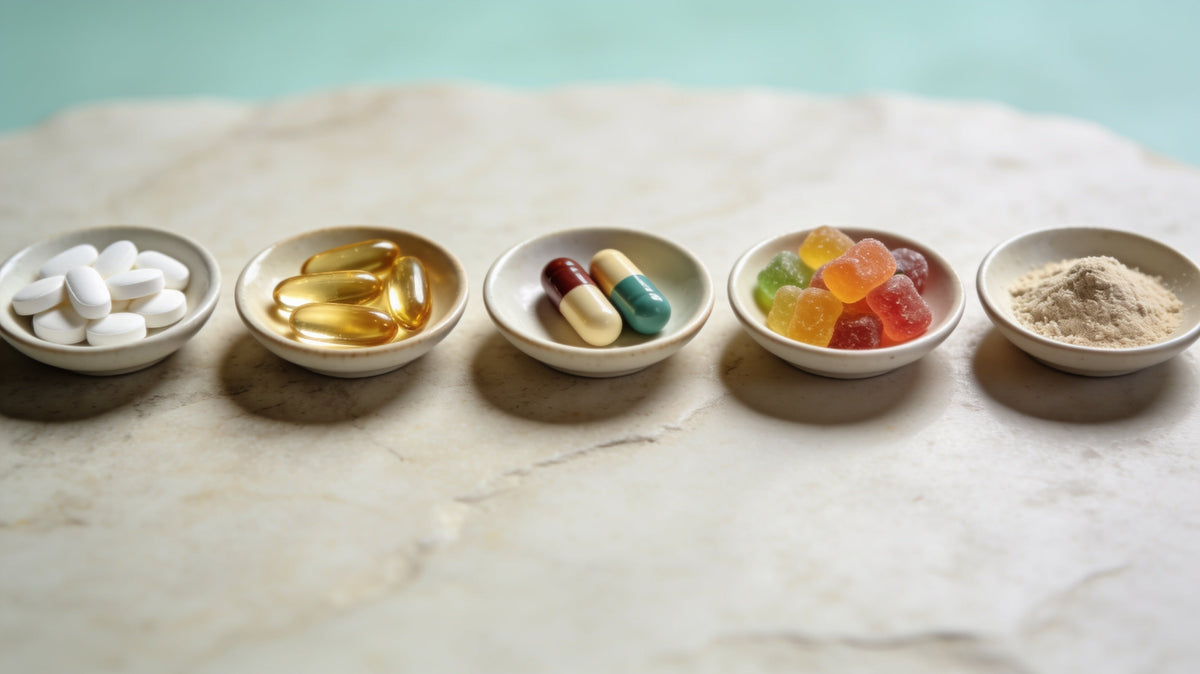
The right supplement format depends on how much active ingredient each serving must carry, how it tastes, how stable it is and how your customer will use it. Capsules and tablets carry dense doses efficiently, gummies win on enjoyment but limit dose and need humidity control, powders suit large servings, and liquids suit those who prefer not to swallow.
Choose a supplement format by working backwards from the daily dose, the taste of the ingredients and how your customer will actually take it. Capsules and tablets carry concentrated doses efficiently, gummies are enjoyable but hold less and need careful humidity control, powders suit large servings such as protein, and liquids suit people who would rather not swallow anything.
Format is one of the first decisions in any private label project and one of the hardest to change later, because it drives the line your product runs on, the packaging, the shelf life work and the unit cost. As an in-house private label supplement manufacturer producing capsules, tablets, gummies, powders, sachets, liquids, syrups and drops, we see brands get the best results when they match format to formula rather than to trend.
The five main formats at a glance
| Format | Dose capacity per serving | Taste masking | Stability considerations | Main cost drivers | Typical packaging |
|---|---|---|---|---|---|
| Capsules | Moderate; limited by capsule size and powder density | Good; contents are enclosed | Shell type and moisture sensitivity of the fill | Shell type, fill complexity, count per pack | HDPE or PET bottles, blisters |
| Tablets | High; compression packs more into each unit | Fair; coating helps | Generally robust; coating protects sensitive actives | Coating, size, compressibility of the blend | Bottles, blisters, tubes for effervescent |
| Effervescent tablets | Moderate to high once dissolved | Good; flavoured drink | Very moisture sensitive | Low-humidity handling, moisture-proof tubes or strips | Tubes with desiccant caps, foil strips |
| Gummies | Low; limited by piece size and taste | Strong need; flavour carries the product | Humidity, heat and active degradation over time | Gelling agent, flavour, sugar or sugar-free base, overages | Bottles or pouches with desiccant |
| Powders and stick packs | Very high; suited to gram-level servings | Needs flavour and sweetener work | Moisture pick-up and caking once opened | Volume of actives, flavour system, pack type | Tubs, pouches, sachets, stick packs |
| Liquids, syrups and drops | Variable; drops suit small doses | Needs flavour work | Microbial control, oxidation, light | Preservation system, bottle and dropper | Glass or PET bottles, dropper closures |
Start with the dose
The daily amount of each active is the single biggest constraint. If your formula needs a large total weight of ingredients per day, a single small gummy or capsule may not hold it, and the serving could become several units, which affects both compliance and cost per day.
- Small, potent actives such as most vitamins work in almost any format.
- Bulky ingredients such as protein, collagen, fibre or greens blends usually point to powders.
- Multi-ingredient formulas with several botanical extracts often fit tablets or capsules best, because compression or encapsulation carries more per unit.
Every ingredient and level must also be permitted for your category; a formulation partner will check this as part of custom formulation.

Taste and the daily experience
Many botanicals, minerals and amino acids taste bitter, metallic or earthy. In capsules and coated tablets that hardly matters. In gummies, powders and liquids, flavour development becomes a large part of the project, and some ingredients are very hard to mask at useful levels.
Think about the customer's routine as well. Gummies and flavoured powders tend to feel like a treat, which helps repeat use. Capsules and tablets are quick and discreet. Drops and syrups suit people who struggle to swallow. Stick packs suit people on the move.
Stability and shelf life
Each format behaves differently over time:
- Capsules and tablets are generally the most stable dry formats when packed with suitable moisture protection.
- Effervescent tablets react with moisture, so they need low-humidity manufacture and tightly sealed packs.
- Gummies are sensitive to heat and humidity, and some vitamins degrade faster in them, which is why overages and stability work matter.
- Powders can absorb moisture and cake once opened, so scoops, liners and resealable closures matter.
- Liquids need a robust preservation approach and protection from light and oxygen for sensitive actives.
Our guide to stability testing, shelf life and overages explains how shelf life is set for each format.
What drives cost in each format
We do not publish prices because cost depends on the formula, but the drivers are predictable:
- Active ingredients. Usually the largest share, especially for speciality extracts.
- Format processing. Coating, low-humidity handling for effervescents, gelling and curing for gummies.
- Flavour and sweetener systems. Significant for gummies, powders and liquids.
- Overages. Extra active added to cover losses over shelf life, which can matter in gummies and liquids.
- Packaging. Bottle, closure, seals, desiccants, printed pouches and secondary cartons.
- Units per day. A format that needs more pieces per serving raises cost per day for the customer.
Minimum order quantities are quoted per format, because each runs on different equipment. Our MOQ and pricing page explains how quotes come together.
Packaging follows format
Capsules and tablets usually go into HDPE or PET bottles with induction seals and desiccants, or into blister packs. Effervescent tablets need moisture-tight tubes or strips. Gummies need moisture protection and enough headspace to avoid sticking. Powders go into tubs, pouches, sachets or stick packs, and liquids into bottles with suitable closures or droppers. Explore options on our custom supplement packaging page, or read the full supplement packaging guide.
A quick decision guide
- Need a high dose of several actives in one serving? Consider tablets or capsules.
- Building an enjoyable daily habit with modest doses? Consider gummies.
- Selling gram-level servings such as protein or collagen? Choose powders or stick packs.
- Serving people who dislike swallowing? Consider effervescent tablets, liquids or drops.
- Selling on the go or in gift sets? Stick packs and sachets travel well.
Matching format to your sales channel
Where and how you sell also points towards a format. Marketplace shoppers compare price per serving and pack count at a glance, so dense formats such as tablets and capsules often present well. D2C and creator brands rely on repeat purchase and social content, where the colour and ritual of gummies or flavoured powders can help. Pharmacies and clinics tend to stock familiar capsule and tablet formats. Gyms and sports retailers expect tubs and single-serve sachets, while hotels, corporate gifting and subscription boxes favour stick packs and compact gift sets. Export buyers may have format preferences set by local habits and climate, so ask your importer early. Choosing one hero format for launch, then extending into a second, is usually easier to manage than launching several formats at once.
Formats made at Harrods Health
We manufacture capsules, tablets including effervescent, gummies, powders, sachets and stick packs, liquids, syrups and drops in-house under an FSSAI licence for nutraceuticals. You can start from a ready formula or a custom one, with flavour development, packaging and label design support, samples before you order and a single account manager.
Frequently asked questions
Which supplement format is cheapest to produce?
There is no universal answer. Cost depends mainly on the actives, then on processing, flavour, overages and packaging. Ask for quotes on two formats for the same formula to compare like for like.
Can any formula be made into a gummy?
No. Gummies hold limited amounts per piece, and some ingredients are hard to mask or unstable in a gummy matrix. A formulation review will show whether a gummy is practical.
Are effervescent tablets harder to manufacture?
They need low-humidity handling and moisture-tight packaging, because they react with water. That adds process and packaging requirements compared with standard tablets.
Can I launch the same formula in two formats?
Often, yes, though levels, excipients and flavours may need adjusting for each format. Each format is quoted and sampled separately.
Not sure which format fits? Share your brief with our nutraceutical manufacturer in India team.
Related service: Nutraceutical manufacturing for your brand →
Tell us your idea. An account manager replies within 1 business day.
More from Harrods Insights


