
Cosmetic Pumps, Sprayers and Closures: Types, Dosage, Neck Finishes and Leak Testing
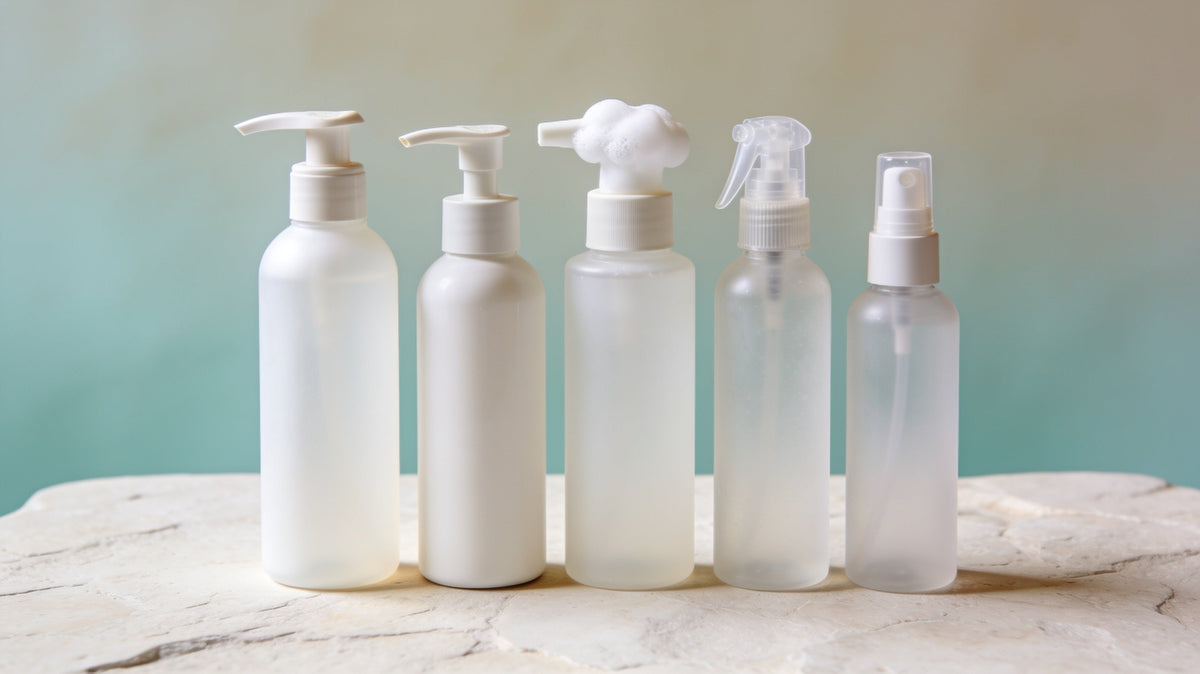
Choose a dispenser by formula viscosity, dose and how the product is used, then match its neck finish to the bottle exactly. Validate locking, dip-tube length and leak performance with your formula before ordering, because most dispensing failures are fit and compatibility problems.
Pick a pump, sprayer or cap by your formula's viscosity, the dose per use and how the product will travel, then match the neck finish to the bottle exactly. Most leaks and dispensing failures come from mismatched neck finishes, wrong dip-tube length or untested formula compatibility, so sample and leak test before you order.
The dispenser is the part of the pack the consumer touches every day. A pump that spits, a sprayer that dribbles or a cap that leaks in a suitcase will undo a good formula. As a cosmetic packaging manufacturer in India, we supply pumps, sprayers and closures alongside bottles so the parts are matched. This guide explains the main types, how to specify them, and how to test them. For category examples, see our body wash packaging guide and our perfume packaging guide.
Types of dispensers and closures
| Dispenser | Typical products | Key specifications |
|---|---|---|
| Lotion pump | Body lotion, body wash, shampoo, hand wash | Output per stroke, lock type, dip-tube length, actuator style |
| Treatment pump | Serums, light lotions, foundations | Smaller dose, finer orifice, often with overcap |
| Foam pump | Face wash, hand wash, mousse cleansers | Air-to-liquid mixing chamber; needs a low-viscosity foaming formula |
| Fine-mist sprayer | Toners, face mists, body mists, hair mists, room sprays | Spray pattern, output per actuation, overcap |
| Trigger sprayer | Hair styling, larger-volume body sprays, home care | Output, spray or stream nozzle, ergonomics |
| Perfume crimp pump | Fine fragrance | Crimped (not screwed) onto the neck; collar finish |
| Flip-top cap | Shampoo, conditioner, cleansers, gels | Orifice size, hinge quality, valve option |
| Disc-top cap | Lotions, toners, cleansers | Press to open; neat dispensing |
| Screw cap | Oils, toners, refills, travel sizes | Liner or wad for sealing |
Browse options in our pump packaging and bottles collections.
Neck finishes: the detail that causes most problems
Bottle necks and closures are specified by a neck finish, commonly written as two numbers such as 24/410. The first number is the nominal outer diameter of the thread in millimetres; the second describes the thread style and height. A closure must match both numbers to seal correctly. Common pitfalls:
- Same diameter, different thread style – a 24/410 pump on a 24/415 neck may screw on but will not seal properly.
- Tolerances between suppliers – two components made to the same nominal finish can still differ slightly. Test the exact pairing.
- Crimp vs screw – fragrance pumps are often crimped onto a specific neck and cannot be swapped for a screw pump.
- Snap-on closures – some caps and pumps snap rather than screw; they need a matching bead on the neck.
Buying bottle and dispenser together, from one supplier, removes much of this risk.

Dosage and output
Pumps and sprayers are specified by the volume dispensed per full stroke. Choose an output that matches how much product a user needs:
- A body lotion or body wash suits a larger output so users are not pumping repeatedly.
- A serum or foundation suits a small, controlled output.
- A face mist suits a fine, even cloud; a hair or body mist may need a wider pattern.
Output varies with formula viscosity, so verify it with your product. If you print a dose instruction ("two pumps"), base it on measured data.
Locking and travel safety
- Left-right (twist) lock – the actuator turns to lock in the down position. Common on lotion pumps.
- Up-lock or clip-lock – a removable clip holds the actuator up during shipping.
- Overcaps – a clear or coloured cap over a treatment pump or sprayer prevents accidental actuation and protects the nozzle.
- Induction seals and inner plugs – for screw-cap bottles in transit; consumers remove them on first use.
For e-commerce and export, a locked pump plus a shrink band or overcap is a sensible baseline. Agree the locking position with your filler so pumps leave the line locked.
Dip tubes
Pumps and sprayers draw product through a dip tube. If it is too short, users cannot reach the last of the product; too long and it curls against the base and can block. The tube should usually be cut to reach the base, sometimes with a slight angle so it sits in the corner where product collects. Specify the bottle height and base design when ordering. See our dip tube collection for replacements and custom lengths.
Material compatibility
Pumps contain several materials: a polypropylene or polyethylene body, a spring that may be metal or plastic, gaskets and sometimes a glass or metal ball valve. Points to check:
- Metal springs in contact with the formula – may corrode with some water-based or acidic products, causing discolouration. Plastic springs or springs outside the product path can help.
- Gasket swelling – essential oils and solvents can swell some gaskets, causing leaks or sticking.
- Clogging – formulas that dry quickly, or contain particles, can block fine-mist nozzles and treatment pumps.
Choosing a dispenser by viscosity
| Formula texture | Suitable dispensers | Avoid or test carefully |
|---|---|---|
| Water-thin (toners, mists) | Fine-mist sprayer, disc cap, orifice reducer | Large-output lotion pumps, which can splash |
| Thin liquid (cleansers, washes) | Lotion pump, flip-top, foam pump if formulated to foam | Treatment pumps with small orifices if the formula is stringy |
| Light lotion or serum | Treatment pump, lotion pump, airless | Fine-mist sprayers |
| Thick cream or gel | High-viscosity lotion pump, airless, tube with flip-top | Standard pumps that cannot draw thick product up a dip tube |
| Oil | Treatment pump, disc cap, sprayer designed for oils | Gaskets not tested against the oil blend |
Actuator design and user experience
The actuator is the brand's handshake. Consider the finger-pad size and shape, the stroke length and resistance, whether the nozzle points the right way when locked, and how the actuator looks with your bottle's shoulder. Metallised collars, coloured actuators and matching overcaps help a stock pump look bespoke. Keep moving parts free of heavy coatings that could crack or stick.
How to leak test pumps, sprayers and caps
A practical leak test programme for samples includes:
- Inverted storage – filled packs stored upside down and on their side, then inspected for seepage.
- Elevated temperature storage – filled packs held warm to reveal seal and gasket weaknesses.
- Vacuum or pressure-differential testing – simulates air freight and altitude.
- Transit or vibration testing – shipping cartons subjected to handling and drop.
- Cycle testing – actuating pumps repeatedly to check consistent output and spring return through the life of the pack.
- Torque checks – confirming application and removal torque on screw closures.
Record what you tested and the conditions used, and keep approved samples. Our testing and quality page explains how we support component checks.
Frequently asked questions
What does 24/410 mean on a pump?
It is the neck finish. 24 is the nominal outer thread diameter in millimetres and 410 describes the thread style and height. The pump and bottle must match both numbers.
Why does my lotion pump leak in transit?
Common causes are a mismatched neck finish, an unlocked actuator, insufficient closing torque, or gasket swelling from the formula. Lock pumps on the line and leak test filled samples.
Can a foam pump work with any face wash?
No. Foam pumps need a thin, foaming formula. Thicker gels will not foam properly and may block the mixing chamber.
How long should the dip tube be?
Long enough to reach the base of the bottle, usually with a slight angle, without curling. Give your supplier the bottle height and base shape so it can be cut correctly.
See our pumps and dispensers or brief our cosmetic packaging manufacturing team.
Related service: Cosmetic packaging manufacturing →
Tell us your idea. An account manager replies within 1 business day.
More from Harrods Insights


