Private Label Lipstick and Lip Tint Manufacturing: Formats, Finishes, Claims and Packaging
Choose the lip format first, because bullet lipsticks, liquid lipsticks and lip tints use different bases, packaging and claims. Finish is then set by the base, and any transfer-resistant or long-wear claim needs a planned wear study. Packaging must be matched to the formula before stability work.
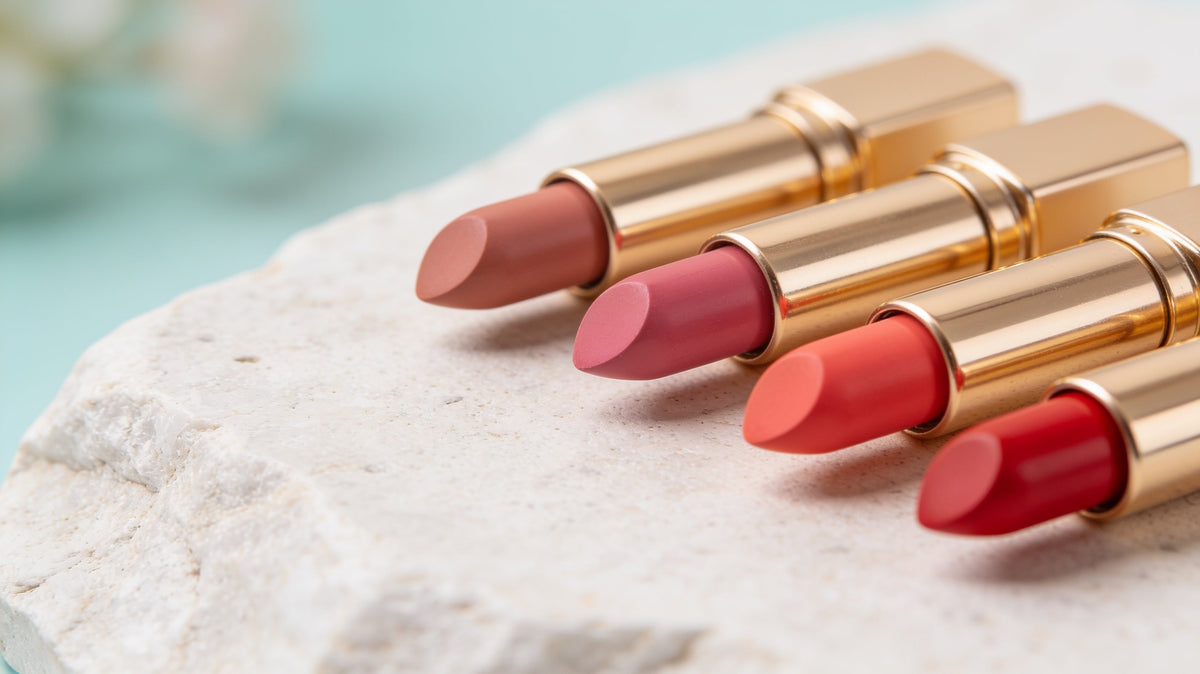
A private label lipstick project starts with format, not colour: bullet lipsticks, liquid lipsticks and lip tints are built on different bases, fill into different packaging and support different claims. Choose the format and finish first, then develop shades within that base.
Lip products are often the first item in a new makeup range, and for good reason. They are giftable, easy to shade-edit, and photograph well. They are also eaten in small amounts with everyday wear, which makes ingredient and flavour choices more important than in many other categories. This guide walks through the decisions behind a lip range from a makeup manufacturer in India, so you can brief clearly and avoid reworking shades later.
Bullet vs liquid vs tint: how the formats differ
| Format | Base | Typical finishes | Packaging |
|---|---|---|---|
| Bullet lipstick | Waxes, oils and butters moulded into a stick | Matte, satin, cream, sheer, metallic | Swivel case, slim or standard bullet |
| Liquid lipstick | Volatile carrier with film formers and pigment that sets on the lips | Matte, velvet, satin | Tube with doe-foot applicator and wiper |
| Lip tint | Water, gel or oil-based stain with lighter pigment load | Sheer, natural, glossy | Tube with applicator, pen or dropper style |
Bullets are the most familiar and the easiest to use. Liquid lipsticks deliver strong colour and are often positioned on staying power. Tints suit a "your lips but better" story and multi-use positioning, for example lip and cheek, which needs a formula and colourants permitted for both areas.
Browse examples in the lipstick collection.
Finishes: what actually changes
Matte
Matte finishes use oil-absorbing powders and a lower level of shiny emollients. The trade-off is comfort: the flatter the finish, the more likely the formula is to feel dry. Good matte development balances payoff with slip and flexibility so the film does not crack along lip lines.
Satin and cream
These sit between matte and gloss, with more emollients for comfort and a soft sheen. They are forgiving on dry lips and tend to suit wide shade ranges.
Gloss and sheer
Higher oil content and lower pigment give a reflective, wet look. For dedicated gloss products, see our separate guide to lip gloss and lip oil manufacturing.
Metallic and pearl
Effect pigments such as mica-based pearls add shimmer. Particle size affects whether the result reads as a fine sheen or visible glitter; check that each effect material is permitted for lip use in your target markets.

Shade development for lips
Lip shades look different in the bullet, on the swatch arm and on the mouth, and different again on different natural lip colours. A sound approval process includes:
- Matching in the final base and finish, never a substitute formula.
- Swatching on people with a range of skin tones and natural lip colours.
- Checking the shade in daylight and indoor lighting, and in photographs if you sell mainly online.
- Retaining the approved sample as the batch standard.
Pairing lipsticks with matching lip liners is common; match the liner to the worn lipstick, not the bullet.
Transfer-resistance and long-wear claims
"Transfer-resistant", "kiss-proof" and wear-time claims are among the most commercially valuable lip claims, and among the most scrutinised. A claim is only as good as the evidence behind it. In most markets, regulators and advertising bodies expect the brand to hold substantiation before the claim is made.
For lips, that usually means a wear study on a panel of users under defined conditions, such as eating and drinking, assessed by a trained evaluator or instrumental method, plus a transfer test, for example pressing against a tissue or cup at set intervals. The wording should reflect what was tested. "Designed for long wear" and "transfer-resistant" claim different things and need different support.
Avoid absolute words such as "100% transfer-proof" or a specific number of hours unless a study supports exactly that. Our article on long-wear, waterproof and transfer-proof claims covers test design and safer wording.
Lip-safe ingredients and flavour
- Colourants: not every pigment permitted in cosmetics is permitted on the lips. Each market publishes its own lists and conditions.
- Flavour and fragrance: lip flavours must be suitable for lip application. Fragrance materials in lip products fall into the most restrictive category of the industry's fragrance standards.
- Claims around ingredients: "vegan" excludes carmine and beeswax; "fragrance-free" means no added fragrance or flavour masking.
Packaging for lipsticks and tints
The case is often the first thing customers touch, and it affects function as well as look:
- Bullet diameter and cup fit must match the moulded bullet, or it may wobble, snap or fail to retract.
- Magnetic and click closures improve the feel but change the component cost and minimum.
- Applicator and wiper for liquids control how much product reaches the lips, and therefore payoff and wear.
- Decoration such as colour moulding, metallisation, hot-stamping or printing usually carries its own minimum.
Lock the component before stability testing, because changing it later can mean repeating that work. Our custom packaging team can match components to the formula.
Quality checks for lip products
Batch checks for lip products typically cover shade against the approved standard, appearance, bullet strength or viscosity, fill weight and microbiological quality where appropriate. Formulas can be supplied as dermatologically tested, with test reports on request.
How lipsticks are made in production
Understanding the production steps helps you brief realistically and read a quotation properly.
- Pigment dispersion: pigments are ground into part of the oil phase so that colour is even and free of specks. Poor dispersion shows up as streaks or a gritty feel on the lips.
- Base melting and mixing: waxes, oils and butters are melted and combined with the colour grind, then any effect pigments are added gently so they are not damaged.
- Shade check: a sample from the batch is compared with the approved standard before filling begins. Small adjustments are made at this stage, not after.
- Moulding or filling: bullets are poured into moulds, cooled and released, then inserted into cases. Liquids and tints are filled into tubes and fitted with applicators and wipers.
- Finishing: bullets may be briefly flamed or polished for a glossy surface, then capped, labelled and packed.
Each step has its own failure modes. Bullets can show sweating (oil droplets on the surface), blooming (a dull white film) or breakage if the wax blend does not suit the climate or the case. Liquids can separate or thicken over time. These are the issues stability testing in the final packaging is designed to catch, which is why skipping it to save time usually costs more later. If you are selling into hot markets, say so in the brief; the wax and oil balance for a bullet that must survive a warm courier van differs from one designed for a temperate climate.
Starting small
A focused first range, perhaps one format in a short edit of carefully chosen shades, is easier to approve, cheaper to stock and quicker to get right. Ready formulas start from 500 units per product; ask for shade MOQs if you need custom colours.
Frequently asked questions
Should I launch with bullet or liquid lipstick?
It depends on your positioning. Bullets are familiar and comfortable; liquids suit bold colour and staying-power stories but need the claims evidence to back them. Many brands launch one format first and add the other later.
Can a lip tint be used on cheeks?
Only if the formula and every colourant in it are permitted for both lip and face use in your target markets, and the product has been assessed for that use. Confirm this before printing multi-use claims.
How do I prove a lipstick is transfer-resistant?
Run a wear and transfer study on a panel of users under defined conditions, then word the claim to match the result. Hold the report before you publish the claim.
What is the MOQ for private label lipsticks?
Ready formulas start from 500 units per product. Custom shades and decorated cases can change the minimum, so ask for shade MOQs for your range.
Building a lip range? See the lipstick collection or start with private label makeup manufacturing.
Related service: Makeup manufacturing for your brand →
Tell us your idea. An account manager replies within 1 business day.
More from Harrods Insights
Keep reading

Reef-Friendly and Ocean-Conscious Hotel Amenities: What the Claims Mean and How to Judge Them

Ayurveda and Wellness Spa Amenities for Sri Lankan Hotels: Massage Oils, Herbal Body Care and Claims