
Private Label Protein, Collagen and Greens Powders: Flavour, Mixability and Packaging Formats
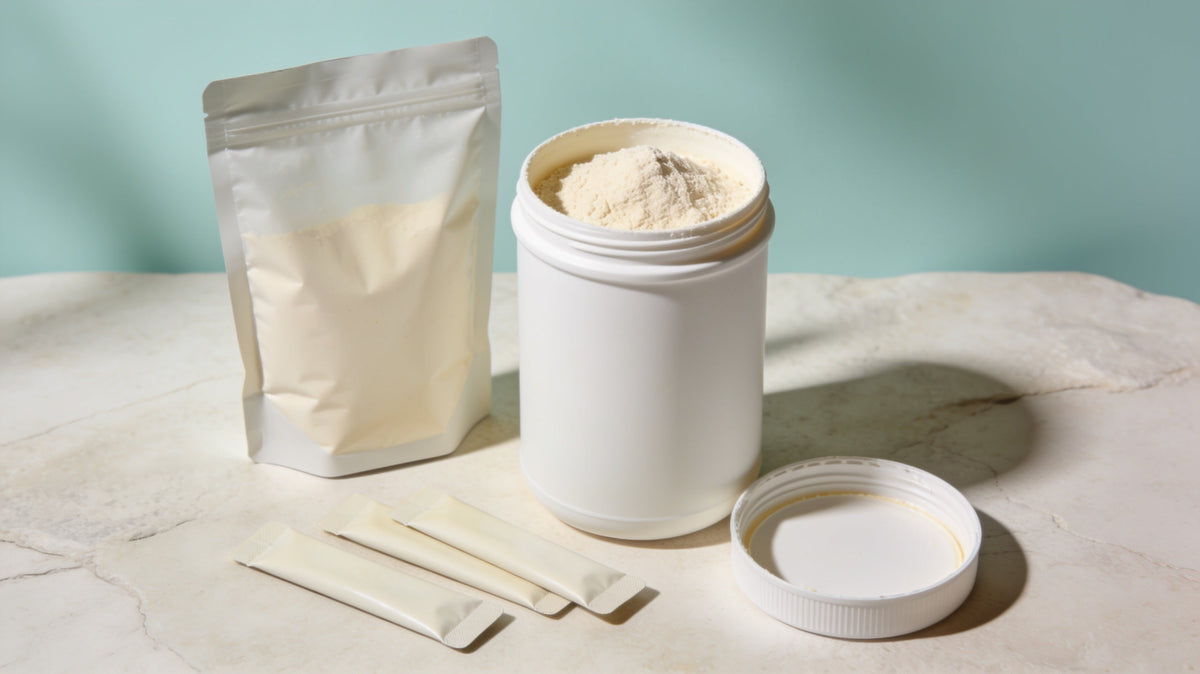
Private label powders start with a base ingredient, then flavour, sweetener and texture work to make them taste good and mix easily. Pack choice, from tubs and pouches to single-serve sachets and stick packs, affects stability, cost and how customers use the product. Labels must match the category and permitted ingredients.
A private label protein, collagen or greens powder is built from a base ingredient, a flavour and sweetener system and agents that help it disperse, then filled into tubs, pouches, sachets or stick packs. The best products balance taste, mixability and label simplicity, and the pack format decides how the powder is used, how well it keeps and what it costs per serving.
Powders are the natural format whenever a serving is measured in grams rather than milligrams. They suit gym and sports nutrition brands, beauty-from-within ranges, pharmacies building their own label and creator brands launching a daily ritual product. Working with an in-house private label supplement manufacturer, you can move from a ready base to a fully custom flavour, and from bulk tubs to single-serve stick packs, under one roof.
Three powder categories, three different challenges
| Powder type | Typical base | Main formulation challenge | Common formats |
|---|---|---|---|
| Protein | Dairy-based or plant-based proteins, alone or blended | Texture, clumping, and masking the taste of plant proteins | Tubs, pouches, single-serve sachets |
| Collagen | Hydrolysed collagen peptides from a stated source | Neutral taste and clear solubility; source and certification for dietary markets | Pouches, tubs, stick packs |
| Greens | Blends of permitted vegetable, grass, fruit and botanical powders | Earthy or bitter taste, colour, and keeping a mixed blend uniform | Tubs, pouches, stick packs |
Choosing the base
Protein
Dairy-based proteins generally give a creamy, familiar taste, while plant-based proteins appeal to vegetarian and vegan customers but bring stronger flavours and grittier textures that need more formulation work. Blends can balance taste, texture and positioning. The protein source and its quality documentation should be agreed at the brief stage, because they drive cost and label claims.
Collagen
Collagen peptides are animal-derived, so source matters for vegetarian, Halal and religious requirements in your markets. The label must state the source accurately, and any dietary certification must cover the specific ingredient and finished product.
Greens
Greens powders combine many ingredients, each of which must be permitted for your category in each market. Blending uniformity matters: particles of different size and density can separate in transit, so the process and particle sizes need control. Botanical ingredients also raise classification questions, covered in our guide to the AYUSH and FSSAI routes for herbal products.

Flavour and sweeteners
Flavour is what turns a powder from something customers tolerate into something they reorder. The flavour team works with the base to cover bitterness, earthiness or dairy notes without making the product cloying.
- Flavours. Natural, nature-identical or artificial flavours, each with its own label declaration and regulatory conditions.
- Sweeteners. Sugar, permitted high-intensity sweeteners or plant-derived sweeteners. Each has taste, label and claim implications, and permitted use depends on category and market.
- Unflavoured options. Popular for collagen and some proteins, but the base must have a clean taste to work.
- Colours. Only permitted colours at permitted levels; many brands prefer the natural colour of the ingredients.
Our custom formulation and flavour development service runs taste rounds on your target liquid, whether water, milk or plant milk, because the same powder tastes different in each.
Mixability: getting a smooth shake
Customers judge a powder in the first few seconds of mixing. Lumps, foam and sediment lead to poor reviews even when the formula is sound. Mixability depends on:
- Particle size and processing of the base, which affects how quickly it wets and disperses.
- Dispersing aids such as permitted emulsifiers, used to help powder wet out instead of floating.
- Flow agents that prevent caking in the pack, within permitted limits.
- Blend order and process control, so every scoop delivers the same composition.
Test samples the way your customer will use them: in a shaker, with a spoon in a glass, and in a blender, in both cold and room-temperature liquids.
Packaging: tubs, pouches, sachets and stick packs
| Format | Strengths | Watch-outs | Best for |
|---|---|---|---|
| Rigid tub with scoop | Familiar, easy to scoop, strong shelf presence | Bulkier to ship; needs an induction seal or liner | Protein, gym retail |
| Stand-up pouch with zip | Lighter, efficient to ship, large print area | Needs a high-barrier laminate and reliable zip | D2C, collagen, greens |
| Single-serve sachet | Exact dose, hygienic, good for trials | More packaging per serving | Sampling, gyms, hotel and travel |
| Stick pack | Slim, portable, premium feel, easy to pour into a bottle | Fill accuracy and sealing need careful control | On-the-go, gift sets, subscription boxes |
Moisture is the main enemy once a pack is opened, so barrier choice and reclosure matter more than appearance. Single-serve formats avoid the problem entirely, which is why many brands launch a tub alongside a box of stick packs. Explore sachets, stick packs and gift sets or our wider custom packaging range, and see the supplement packaging guide for barrier and seal options.
Think about the full customer journey too. A trial box of stick packs can introduce a flavour range at low commitment, while a refill pouch rewards loyal customers and reduces packaging per serving. Planning these formats together keeps labels, flavours and specifications consistent across the range.
Labelling and claims for powders
- State the category correctly and use only permitted ingredients within limits.
- Give composition per serving, with serving size measured as customers will use it.
- Declare allergens where required, particularly with dairy-based ingredients.
- Use the correct vegetarian or non-vegetarian symbol; collagen is animal-derived.
- Keep claims to permitted, substantiated nutrient-function or general wellbeing language. Avoid disease claims and guaranteed outcomes such as promised muscle gain or weight loss.
Sampling and approving a powder
Powder sampling works best when it mirrors real use. Agree in advance what you will judge and how, so feedback between rounds is specific rather than general.
- Taste in the intended liquid, at the stated serving size and at the temperature customers will use.
- Mixability in a shaker, a glass and a blender, noting lumps, foam and any sediment after a few minutes.
- Appearance and colour of both the dry powder and the made-up drink.
- Aftertaste and sweetness level, ideally assessed by several people from your target audience.
- Scoop and serving fit, so the scoop delivers the labelled serving and fits the tub or pouch.
Once a sample is approved, the flavour, sweetener and base specification are locked so that production batches match what you signed off. Changes after approval usually mean another sampling round.
Powders at Harrods Health
We manufacture powders, sachets and stick packs in-house under an FSSAI licence for nutraceuticals, in a facility that is also ISO certified, GMP-compliant, Halal certified, AYUSH licensed and US FDA registered. Choose a ready formula or custom development with flavour work, packaging and label design, samples before you order and a single account manager. MOQ is quoted per format and pack.
Frequently asked questions
Can I private label a protein powder with my own flavour?
Yes. You can start from a ready base and develop a custom flavour, or build a fully custom formula. Flavour rounds are part of sampling before you order.
Are stick packs suitable for protein powder?
Stick packs suit smaller single servings such as collagen, greens and electrolyte-style powders. Larger protein servings usually fit sachets, pouches or tubs better.
How do you stop powders from clumping?
Through particle size control, permitted dispersing and flow agents, good blending, a high-barrier pack and an effective seal or reclosure.
Is collagen powder vegetarian?
No. Collagen is animal-derived, so it carries the non-vegetarian symbol in India, and its source must be stated and suitable for any dietary or Halal claims.
Planning a powder range? Talk to our nutraceutical manufacturer in India team.
Related service: Nutraceutical manufacturing for your brand →
Tell us your idea. An account manager replies within 1 business day.
More from Harrods Insights
Keep reading
Multilingual Labelling for Hotel Toiletries in South-East Asia: Languages, Small-Pack Layout and Halal Logo Rules

Sustainable Hotel Amenities in Singapore and South-East Asia: Refill Systems, PCR Plastic and Substantiating Green Claims