Stability and Compatibility Testing for Skincare: What Brands Should Ask For
Stability testing shows whether a skincare formula keeps its look, feel, smell and performance over time, while compatibility testing checks it behaves in the actual pack. Challenge testing confirms the preservative system protects the product in use. Ask for all three before you commit to a production run.
Stability and compatibility testing tells you whether a skincare product will stay as you approved it, in the packaging you chose, until the end of its shelf life. Brands should ask about accelerated and real-time stability, freeze-thaw cycling, packaging compatibility and preservative efficacy (challenge) testing before approving a formula for production.
A sample that looks perfect on your desk tells you very little about how the product will behave after months in a warehouse, a delivery van in summer or a bathroom shelf. Testing closes that gap. As a skincare manufacturer in India, Harrods Health supports brands through this stage; this guide explains each test in plain language, what it can and cannot show, and the questions worth asking.
Why stability matters for skincare
Skincare formulas are mixtures of water, oils, emulsifiers, thickeners, actives, preservatives and often fragrance. Over time, and especially with heat, light and air, these can change. Typical stability failures include:
- separation of an emulsion into oily and watery layers;
- thinning or thickening, so a serum no longer drops or a cream no longer pumps;
- colour change, common with vitamin C and some botanical extracts;
- odour change, as fragrance or oils oxidise;
- a shift in pH that affects comfort, preservation or how an active behaves;
- crystals or sediment as an ingredient comes out of solution.
Each of these leads to returns, poor reviews and, in some cases, safety concerns. Stability testing is how you find them before your customers do.
The main types of stability testing
Accelerated stability
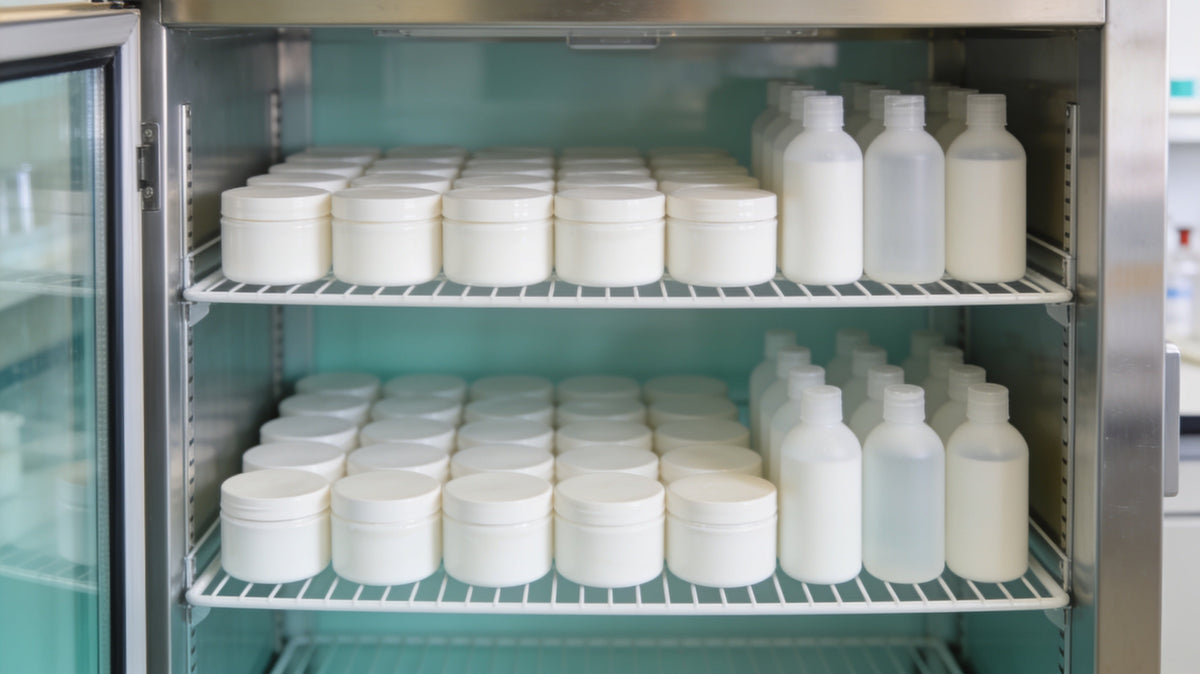
Samples are stored at elevated temperatures for a set period and checked at intervals. Heat speeds up many chemical and physical changes, so accelerated testing gives an early indication of how the product may behave over a longer time. It is a screening tool, not a guarantee of shelf life: some changes do not scale neatly with temperature, and heat can also cause failures that would never occur at normal storage.
Real-time stability
Samples are stored at normal room conditions and checked over the intended shelf life. Real-time data is the most reliable evidence for shelf life, but it takes as long as the shelf life itself. Many brands launch on the basis of accelerated data and continue real-time testing in parallel, reviewing the results as they come in.
Freeze-thaw cycling
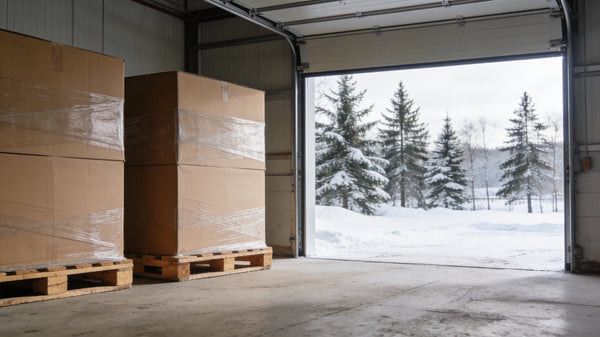
Samples are moved repeatedly between cold and warm conditions. This shows whether an emulsion breaks, a gel weeps or ingredients crystallise when products travel through cold chains, air freight or winter climates. It is especially relevant for export.
Light exposure
Products in clear or translucent packs, or with light-sensitive ingredients such as retinol, vitamin C or certain colours, are checked under light to see whether colour, odour or appearance changes.

What is measured at each check
| Parameter | What it tells you |
|---|---|
| Appearance and colour | Separation, sediment, darkening or fading |
| Odour | Fragrance stability and oxidation of oils |
| pH | Chemical drift that can affect comfort, actives and preservation |
| Viscosity | Whether texture and dispensing stay consistent |
| Microscopic or physical checks | Emulsion structure and crystal formation |
| Weight loss | Water evaporation through the pack or closure |
| Microbial quality | Whether the product remains within acceptable limits |
For products sold on an active claim, brands may also want the active content checked over time, so a percentage claim remains accurate through shelf life.
Packaging compatibility testing
A formula does not live on its own; it lives in a pack. Compatibility testing stores the product in the actual packaging, with the actual closure, and checks both the product and the pack. It can reveal:
- oils or solvents softening, swelling or stress-cracking plastic;
- fragrance or actives being absorbed into the pack wall;
- printing or labels lifting, smudging or discolouring;
- pumps clogging or failing to prime with a thicker formula;
- tube collapse, panelling or leakage at the crimp or cap;
- weight loss through permeable materials.
This is why changing from a glass dropper to a plastic dropper, or from a jar to an airless pump, should prompt a fresh look at compatibility. For a deeper look at formats, read our guide to choosing skincare packaging or browse airless bottles.
Preservative efficacy (challenge) testing
Any product containing water can support microbial growth once it is opened and used. A challenge test deliberately introduces specific micro-organisms into the product and measures whether the preservative system reduces them over a defined period. ISO 11930 is a widely used international method for evaluating the antimicrobial protection of cosmetics.
Challenge testing matters most for:
- water-rich products such as gels, toners, mists and lotions;
- jars, where fingers enter the product;
- "preservative-free" or minimally preserved positioning, which needs particularly careful design;
- any reformulation that changes pH, water content or the preservative system.
Anhydrous products, such as face oils and some balms, are generally lower risk but still need sensible manufacturing hygiene.
Questions to ask your manufacturer
- Which stability tests have been carried out on this formula, at what conditions and for how long?
- Was testing done in the same packaging I have chosen? If not, what compatibility work is planned?
- Has the preservative system been challenge-tested, and by which method?
- What shelf life and period after opening does the data support?
- What changes are considered normal for this formula, such as slight colour shift?
- If I change fragrance, colour or packaging, which tests need repeating?
- Can I receive copies of the reports for my product file and export documents?
Test reports are available on request at Harrods Health, and formulas can be supplied as dermatologically tested. See our testing and quality and certifications pages for how quality is managed in our ISO certified, GMP-compliant facility.
Ready formulas and custom formulas
A key advantage of starting from a ready formula is that it has a production and testing history. You will still need compatibility work if your packaging is new to that formula, but the base risk is lower. Custom formulas need the full sequence before production, which is one reason custom development takes longer; read more on custom formulation.
Common mistakes to avoid
- Approving a formula from a sample in glass, then producing in plastic without checking.
- Changing fragrance late "because it is only scent".
- Printing a shelf life the data does not support.
- Treating accelerated data as final and never reviewing real-time results.
- Skipping freeze-thaw work for products that will be air-freighted or exported to cold climates.
Testing is not a one-off hurdle. Treat it as a living file for each product, updated whenever you change a component, a raw material supplier or a target market.
Frequently asked questions
How long does skincare stability testing take?
Accelerated testing gives early indications over a shorter period, while real-time testing runs for the intended shelf life. Many brands launch on accelerated data and continue real-time testing in parallel.
What is a challenge test?
A challenge test adds specific micro-organisms to a product and checks whether the preservative system reduces them over time. ISO 11930 is a widely used method for evaluating the antimicrobial protection of cosmetics.
Do I need new testing if I change packaging?
Usually some compatibility work is advisable, because a formula can behave differently in a new material, closure or pump. Discuss the change with your manufacturer before ordering components.
Can I get copies of the test reports?
Yes. Test reports are available on request at Harrods Health, which is useful for your product file, marketplace listings and export documentation.
Want a formula with a testing history behind it? Explore private label skincare manufacturing at Harrods Health.
Related service: Skincare manufacturing for your brand →
Tell us your idea. An account manager replies within 1 business day.