
Sustainable Cosmetic Packaging: PCR, Mono-Material, Refills, Glass, Aluminium and Honest Green Claims
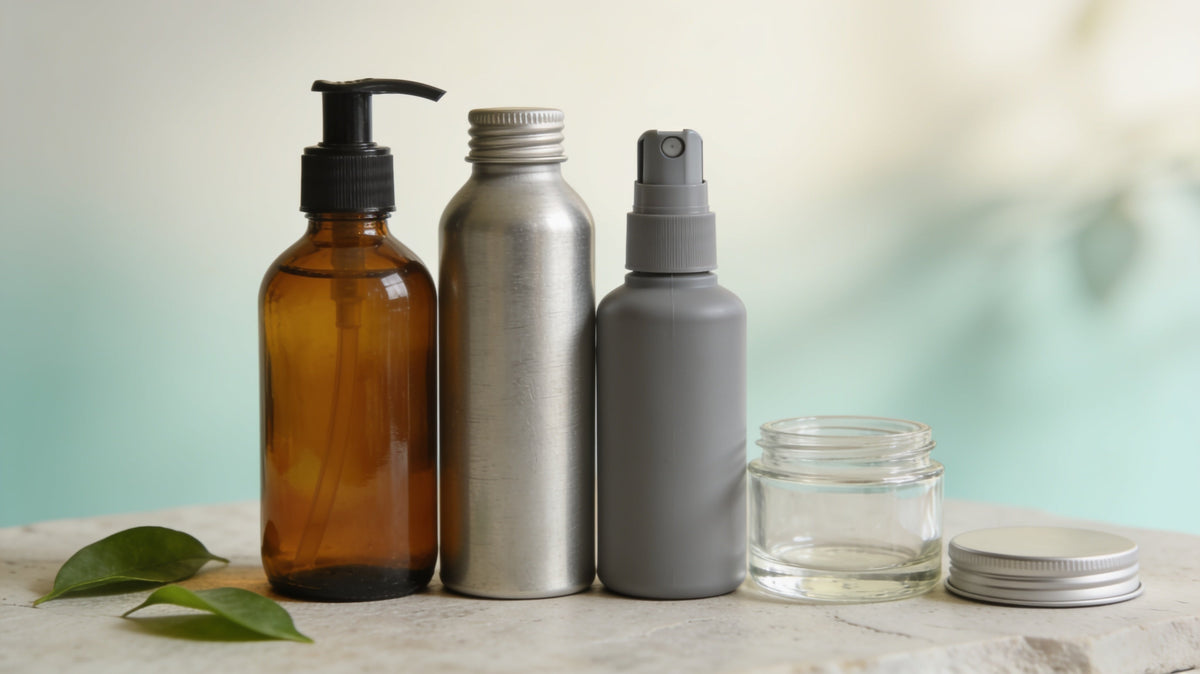
More sustainable cosmetic packaging comes from specific, measurable choices: using less material, adding recycled content, designing for the recycling systems that actually exist, and offering refills people will use. Every environmental claim on pack must be specific and backed by evidence, and Indian brand owners also need to meet extended producer responsibility obligations for plastic packaging.
Sustainable cosmetic packaging is not one material but a set of measurable decisions: use less, use recycled content such as PCR plastic where it performs, design packs that real recycling systems can process, and offer refills that customers will actually use. Any claim you make about these choices must be specific, accurate and supported by evidence.
Retailers, regulators and consumers are all asking harder questions about packaging. For beauty and personal care brands, that creates both pressure and opportunity. As a cosmetic packaging manufacturer in India, we supply PCR, mono-material, glass, aluminium and refillable options, and we see what works in practice. This guide sets out the main levers, the trade-offs, and how to talk about them responsibly. Shortlist formats in our eco packaging and refillable packaging collections.
Start with the hierarchy: reduce, reuse, recycle
- Reduce – lighter walls, smaller caps, fewer components, no unnecessary outer cartons or oversized double walls.
- Reuse and refill – durable primary packs that are refilled from lighter refill formats.
- Recycle – packs designed so that collection and sorting systems can recover the material.
- Recycled content – using post-consumer recycled (PCR) material to reduce demand for virgin resin.
The best option depends on your product, your markets and how your customers dispose of packaging. A lifecycle perspective helps avoid swapping one impact for another, for example choosing heavy glass that raises transport emissions for a product shipped long distances.
PCR plastics
Post-consumer recycled plastic is made from packaging that consumers have used and discarded, collected and reprocessed. PCR versions of PET, HDPE and PP are increasingly used in bottles, jars and tubes.
What to know about PCR
- Appearance can vary. PCR may have a slight tint, specks or batch-to-batch variation, especially in clear materials. Approve a colour range, not a single perfect sample.
- Performance must be tested. Compatibility, stress cracking and drop performance should be confirmed with your formula.
- Traceability matters. Ask for documentation of the recycled content percentage and its source so you can substantiate any claim.
- Regulatory suitability. Check the requirements in your target markets for recycled materials in contact with cosmetic products.
- PIR versus PCR. Post-industrial recycled material comes from manufacturing scrap; do not describe it as post-consumer.

Mono-material design
A mono-material pack uses one polymer family across its components, for example a PP bottle, PP cap and PP pump body. Mono-material design can make sorting and recycling simpler, because there is less need to separate incompatible plastics. In practice:
- Pumps often contain metal springs; ask about all-plastic spring alternatives.
- Labels, adhesives and inks should be compatible with the recycling stream.
- Barrier layers, metallisation and heavy coatings can complicate recycling.
- Dark colours, especially carbon-black pigments, can be hard for some optical sorting systems to detect.
Mono-material helps, but recyclability ultimately depends on whether the material is collected and recycled where the pack ends up.
Refillable systems
Refills can cut material use substantially over a product's life, but only if customers buy them. Common models:
- Refill cartridges or pods that click into a durable outer, such as refillable airless and jar inserts.
- Refill pouches or bottles used to top up a durable dispenser, common for body wash and hand wash.
- In-store or service refills, where the brand or retailer refills the customer's container.
Design the refill to be easy, clean and intuitive, price it to encourage repeat purchase, and keep refills available for as long as the durable pack is in use. Our body wash packaging guide covers refill formats for wash products.
Lightweighting and right-sizing
Often the quickest gain is simply using less. Ask whether a stock bottle is available in a lighter-weight version, whether the cap can be smaller, and whether an outer carton is needed at all for products sold online. Right-size the pack to the fill volume, and avoid deep false bases or thick double walls that add material without adding product. Lighter, smaller packs also reduce freight weight and volume for export shipments.
Glass and aluminium
| Material | Strengths | Trade-offs |
|---|---|---|
| Glass | Inert, premium, good barrier; widely collected in many regions; can contain recycled cullet | Heavier, so higher transport impact; breakable; decorations and mixed closures affect recycling |
| Aluminium | Light, strong, good barrier; widely collected in many regions | Usually needs an internal lacquer; dents; pumps and caps may be other materials |
Neither material is automatically the better choice. Compare total weight, transport distance, breakage and end-of-life routes for your markets.
Design for recycling checklist
- Use a single polymer family where possible, or make components easy to separate.
- Choose clear or light colours over dark pigments where recycling is a goal.
- Keep labels and sleeves compatible, or make them easy to remove; our decoration team can advise on direct print versus labels.
- Minimise metallisation and heavy coatings on main bodies.
- Avoid unnecessary components such as overcaps and separate inner jars.
- Design for full evacuation, because residue can hinder recycling.
- Provide clear disposal instructions appropriate to each market.
Making green claims you can stand behind
Regulators in many markets are tightening rules on environmental claims. India's consumer protection authority has issued guidance on misleading environmental claims, the UK has a Green Claims Code, the EU has adopted rules restricting generic environmental claims, and the US has long-standing guidance on environmental marketing. The details differ, so take local advice, but the principles are consistent:
- Be specific. "Bottle made with recycled PET", stated with the percentage you can document, is a claim you can verify; vague words such as "green", "natural packaging" or "planet-safe" are not.
- Specify the component. If only the bottle contains recycled plastic, do not imply that the cap and pump do too.
- Do not overstate recyclability. A pack is only recyclable in practice if it is widely collected, sorted and reprocessed where it is sold. Avoid absolute claims, and qualify claims where facilities are limited.
- Hold the evidence. Keep supplier declarations, test reports, certificates and calculations on file before the claim goes live.
- Avoid misleading imagery. Leaves, globes and green colours can imply a claim in themselves.
- Compare fairly. "Less plastic" needs a clear basis: less than what, and by how much?
We will provide the material and component information your claims depend on, but the brand owner is responsible for the claims made on its products.
India's extended producer responsibility for plastic packaging
In India, the Plastic Waste Management Rules, as amended, include extended producer responsibility (EPR) guidelines for plastic packaging. In general terms:
- Producers, importers and brand owners that place plastic packaging on the Indian market are expected to register through the Central Pollution Control Board's centralised EPR portal.
- Plastic packaging is grouped into categories, such as rigid, flexible and multilayer packaging, with obligations that can cover collection, recycling, reuse and the use of recycled content.
- Obligated businesses file periodic returns and may meet obligations through registered processors and EPR certificates.
- Labelling and reporting requirements may apply to packaging.
Rules and targets are updated from time to time, so check the current notifications or take specialist advice. Importers bringing products into other markets should also check local EPR or packaging-tax schemes.
Frequently asked questions
Is PCR packaging as good as virgin plastic?
PCR can perform well in many applications, but appearance may vary and performance must be tested with your formula. Approve a colour range and run compatibility checks.
Can I call my packaging recyclable?
Only if you can show it is collected, sorted and recycled in practice in the markets where it is sold, and you should qualify the claim where facilities are limited. Avoid absolute claims you cannot substantiate.
Do refillable packs always reduce environmental impact?
Not automatically. The benefit depends on customers buying refills and on the refill format using less material than buying a new pack each time.
Does EPR apply to cosmetic brands in India?
Brand owners, producers and importers placing plastic packaging on the Indian market generally fall under the plastic packaging EPR framework. Check the current rules or take specialist advice for your situation.
Shortlist PCR and mono-material packaging or talk to our cosmetic packaging manufacturing team about lower-impact options.
Related service: Cosmetic packaging manufacturing →
Tell us your idea. An account manager replies within 1 business day.
More from Harrods Insights


