
Carrier Oils for Massage Oils Compared: Feel, Absorption, Shelf Life and Cost
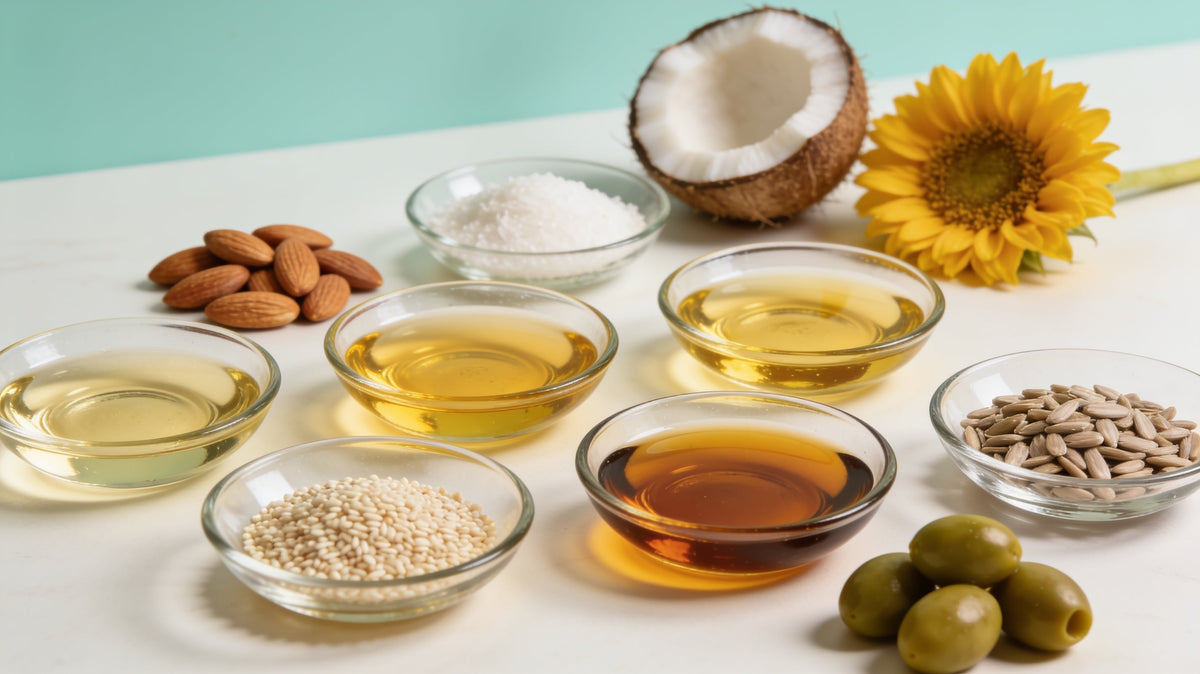
The best carrier oil for a massage oil depends on how long the oil must stay workable on skin, how quickly it should absorb and how long it must stay fresh on the shelf. Slower-absorbing oils such as sesame, sweet almond and olive suit longer treatments, while fractionated coconut, grapeseed and jojoba feel lighter. Most commercial massage oils blend two or three carriers and add an antioxidant to balance feel, stability and cost.
No single carrier oil is best for every massage oil: sesame, sweet almond and olive give a longer, richer glide, while fractionated coconut, grapeseed and jojoba feel lighter and absorb faster. Most professional formulas blend two or three carriers to balance workability, shelf life and cost.
The carrier oil makes up most of a massage oil, so it decides how the product feels in a therapist's hands, how it behaves on a client's skin and how long it stays fresh in a bottle. When brands brief a massage oil manufacturer in India, the carrier choice is usually the first technical decision. This guide compares the eight carriers we are asked about most often and explains the trade-offs behind each one.
What to judge a carrier oil on
- Glide and workability: how long the oil stays on the skin surface so hands can move without dragging. Long treatments need more working time.
- Absorption and after-feel: whether the skin feels nourished, satin-like or greasy once the massage ends. Retail body oils often aim for a quicker, cleaner finish.
- Odour and colour: some oils carry a natural scent or tint that affects the fragrance and the look of the finished product.
- Oxidative stability: how resistant the oil is to going rancid. Oils rich in polyunsaturated fatty acids tend to oxidise faster.
- Cost drivers: crop availability, refining grade, cold-pressed versus refined, organic certification and currency movements all affect raw-material cost.
- Allergen and labelling considerations: nut- and seed-derived oils may need attention on labels or in customer communications.
Carrier oils compared
The comparison below uses relative terms. Actual behaviour depends on grade, refining and the rest of the formula, so treat it as a starting point for sampling rather than a specification.
| Carrier (INCI) | Feel and glide | Absorption | Relative shelf stability | Main cost drivers |
|---|---|---|---|---|
| Sesame (Sesamum Indicum Seed Oil) | Medium to rich, long working time | Moderate | Good; contains natural antioxidant compounds | Grade (untoasted cold-pressed versus refined), crop |
| Sweet almond (Prunus Amygdalus Dulcis Oil) | Medium, smooth classic massage glide | Moderate | Moderate | Almond crop, refining, origin |
| Coconut (Cocos Nucifera Oil) | Rich when melted; solid in cool rooms | Moderate | Good | Virgin versus refined grade |
| Fractionated coconut (Caprylic/Capric Triglyceride) | Light, silky, non-greasy | Fast | Very good | Processing; widely available |
| Jojoba (Simmondsia Chinensis Seed Oil) | Light to medium, satin finish | Fast to moderate | Very good; technically a liquid wax | Limited growing regions, golden versus refined |
| Grapeseed (Vitis Vinifera Seed Oil) | Light, thin | Fast | Lower; prone to oxidation | Generally economical |
| Sunflower (Helianthus Annuus Seed Oil) | Light to medium | Moderate | Varies; high-oleic types are more stable | Generally economical; high-oleic grades cost more |
| Olive (Olea Europaea Fruit Oil) | Rich, heavy, long glide | Slow | Good | Grade and natural odour; refined grades smell less |
| Apricot kernel (Prunus Armeniaca Kernel Oil) | Light to medium, soft | Moderate to fast | Moderate | Kernel supply, refining |

Notes on each carrier
Sesame oil
Sesame is the traditional base for Indian body oiling and herbal tailas. Untoasted, cold-pressed or refined sesame has a mild odour suitable for massage; toasted sesame, used in cooking, smells too strong. Its natural antioxidant content gives it useful stability. Sesame is a recognised food allergen in many markets, which some brands choose to highlight in customer information.
Sweet almond oil
Sweet almond is the benchmark many therapists know. It has a comfortable, even glide and leaves skin feeling soft. Because it is nut-derived, brands selling into spas often mention it clearly so therapists can check with clients who have nut allergies.
Coconut and fractionated coconut
Virgin coconut oil turns solid in cool rooms, which is attractive for a balm-style product but inconvenient in a pump bottle. Fractionated coconut oil, known in ingredient lists as caprylic/capric triglyceride, stays liquid, has almost no odour or colour, resists oxidation and leaves a light, dry-touch finish. It is a common backbone for retail body oils and aromatherapy blends.
Jojoba oil
Jojoba is a liquid wax rather than a true triglyceride oil, which is why it is so resistant to rancidity. It feels silky and absorbs well. It is usually more costly than other carriers, so many formulas use it as a supporting ingredient rather than the main base.
Grapeseed and sunflower oils
Both are light and economical. Grapeseed absorbs quickly but oxidises faster than most carriers, so it needs an antioxidant and sensible packaging. Sunflower comes in different types; high-oleic sunflower is noticeably more stable than standard high-linoleic grades and is a practical base for value ranges.
Olive oil
Olive oil is rich and slow to absorb, which suits deep, long massage strokes, but its natural green colour and odour can clash with fine fragrance. Refined grades reduce this. It is often used in smaller proportions to add richness.
Apricot kernel oil
Apricot kernel oil behaves much like sweet almond but feels slightly lighter. It is a popular choice for gentler body oils and smaller-format products where a soft, refined feel matters.
Why most massage oils are blends
A single carrier rarely ticks every box. A typical approach is to combine a slower-absorbing base for working time with a lighter oil for a cleaner finish, then add a small amount of a stable oil such as jojoba. For example, a spa back-bar oil might pair sesame or sweet almond with fractionated coconut, while a retail body oil might lead with fractionated coconut and apricot kernel. Our custom formulation team can build and sample blends against your brief, or you can start from an existing base in our body oil collection.
Protecting shelf life
- Add an antioxidant. Tocopherol (vitamin E) is widely used to slow oxidation, especially in blends containing grapeseed, sunflower or other polyunsaturated oils.
- Control light and heat. Amber or opaque packs, cartons and cool storage all help. Clear packs look attractive but expose oil to light.
- Limit headspace and air. Pumps and well-fitted closures reduce air exposure compared with wide-neck jars.
- Use fresh raw materials. Each incoming oil batch should be checked against its specification before use.
- Run stability checks on the finished blend in the chosen pack so the shelf life you print is supported.
Matching carriers to your channel
| Use case | Typical carrier direction |
|---|---|
| Spa and salon full-body treatments | Medium-glide base (sesame, sweet almond) with a lighter oil for finish |
| Ayurvedic abhyanga and herbal tailas | Sesame or coconut base, often herb-infused |
| Retail body oils and dry-touch oils | Fractionated coconut, apricot kernel, jojoba |
| Value or bulk hotel ranges | Sunflower (ideally high-oleic) blended with a stable oil |
| Aromatherapy blends | Low-odour carriers such as fractionated coconut or refined sweet almond |
For the difference between a massage oil, a body oil and a dry oil, see our guide to body oil vs massage oil vs dry oil.
Frequently asked questions
Which carrier oil absorbs fastest for a massage oil?
Fractionated coconut oil and grapeseed oil are among the fastest-absorbing carriers, with jojoba close behind. They give a lighter finish but less working time, so they are often blended with a richer oil for full-body massage.
Which carrier oil has the longest shelf life?
Jojoba and fractionated coconut are among the most oxidation-resistant carriers. Shelf life still depends on the full blend, antioxidant use, packaging and storage, so it should be confirmed with stability checks.
Is coconut oil good for a massage oil?
Virgin coconut oil solidifies in cool rooms, which suits balms but not pump bottles. Fractionated coconut oil stays liquid and is a common choice for light, non-greasy massage and body oils.
Should I avoid nut oils in a spa massage oil?
Not necessarily, but label nut-derived oils clearly so therapists can ask clients about allergies. Some spas also keep a nut-free option based on sunflower, fractionated coconut or jojoba.
Want to sample carrier blends for your range? Speak to our massage oil manufacturer team.
Related service: Massage oil manufacturing for your brand →
Tell us your idea. An account manager replies within 1 business day.
More from Harrods Insights
Keep reading
Multilingual Labelling for Hotel Toiletries in South-East Asia: Languages, Small-Pack Layout and Halal Logo Rules

Sustainable Hotel Amenities in Singapore and South-East Asia: Refill Systems, PCR Plastic and Substantiating Green Claims