
Cosmetic Packaging Manufacturer in India: Stock vs Custom, MOQs, Lead Times and Samples

Stock packaging is the fastest, lowest-risk route for most launches; custom moulds make sense once a design is proven and volumes justify tooling. MOQs and lead times depend on the item, material, colour and decoration, so request samples and a written quote for your exact specification before committing.
A cosmetic packaging manufacturer supplies the bottles, jars, tubes, pumps and closures your formula ships in, either from a stock catalogue or made to your own design. For most brands the smartest path is to launch on decorated stock components, sample everything in your actual formula, and move to custom moulds only when the product and volumes are proven.
Whether you run a skincare start-up, a fragrance house adding body care, a contract filler sourcing components for clients, or an importer building a retailer's own label, the same questions come up: what can I buy off the shelf, what has to be made, how many must I order, and how long will it take? This guide answers those questions in plain terms. If you are evaluating a cosmetic packaging manufacturer in India, use it as a checklist for your first conversations.
What a cosmetic packaging manufacturer actually supplies
Primary packaging is everything that touches the formula: the container, the dispensing system and the closure. Secondary packaging, such as cartons and gift boxes, protects and presents the primary pack. Most beauty buyers source primary components in four families:
- Containers – bottles, jars, tubes, vials, lip and mascara components, compacts and perfume bottles.
- Dispensers – lotion and treatment pumps, foam pumps, fine-mist and trigger sprayers, droppers and airless systems.
- Closures – screw caps, flip-top and disc caps, overcaps, wadded caps and shrink-sleeve tamper evidence.
- Decoration – printing, hot stamping, labels, coatings and finishes applied to any of the above.
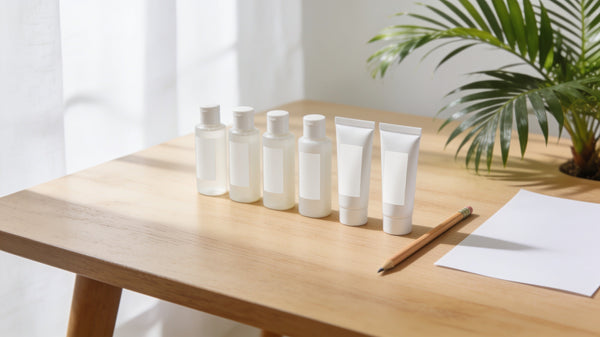
Harrods Health manufactures cosmetic packaging and supplies it either empty or filled with its own formulas. The range covers more than 2,500 items, including airless bottles and jars, dropper bottles, jars, tubes, bottles, pumps and dispensers, sprayers, lip and mascara packaging, perfume bottles, compacts, and eco and refillable formats. You can browse many of them as plain stock in our unlabelled packaging collection.
Stock packaging vs custom packaging
The single biggest decision is whether to build on existing moulds or commission your own. The table below summarises the trade-offs.
| Factor | Stock (catalogue) packaging | Custom mould packaging |
|---|---|---|
| Upfront cost | No tooling; you pay per piece and for decoration | Mould and development costs before the first piece |
| Speed | Fastest route to market | Longest route: design, tooling, trials, approval |
| Differentiation | Achieved through colour, decoration and closure choice | Unique silhouette that competitors cannot buy |
| Risk | Low; components are already proven in production | Higher; new shapes need fit, drop and leak validation |
| Best for | Launches, test markets, wide ranges, private label | Hero SKUs with proven demand and a long life |
Stock does not mean generic. A standard bottle with a coloured body, a metallised collar, a printed or hot-stamped mark and a contrasting cap can look entirely bespoke. Our branding and decoration team handles printing, hot stamping, labels and finishes in-house, which is often where a stock pack becomes your pack. When a unique shape is genuinely worth it, read our guide to custom mould cosmetic packaging.

How MOQs are set (and why there is no single number)
Minimum order quantities are not arbitrary. They reflect the economics of each process step, and a single pack can carry several. Expect MOQs to vary with:
- The item itself – a popular stock bottle in natural or clear material is usually easier to supply in modest quantities than a niche component.
- Colour – a custom moulded colour needs a dedicated masterbatch run; a stock colour does not.
- Decoration – each print colour needs a screen or plate, each foil a die, and each set-up has a cost that must be spread across the run.
- Material grade – recycled content, special resins or particular glass treatments may have their own supply minimums.
- Assembly – fitting pumps, inserting dip tubes or pre-assembling caps adds steps that are planned in batches.
Because of this, a reputable supplier will quote MOQs per item and per decoration rather than one figure for everything. Our MOQ and pricing page explains how we quote. The practical tip: if your volumes are small, keep decoration simple (fewer colours, labels instead of direct print) and choose stock colours.
Lead times: what drives them
Lead time is the sum of several stages, and any one can become the bottleneck:
- Specification and quotation – faster when your brief is complete.
- Sampling and approval – including your compatibility checks in the real formula.
- Artwork approval – proofs, colour standards and position drawings.
- Production – moulding or forming, then decoration, then assembly.
- Quality inspection and packing – to your agreed acceptance criteria.
- Dispatch – domestic delivery or export documentation and freight.
Stock undecorated items generally move fastest; custom colours and multi-step decoration take longer; new moulds take longest of all. Build packaging into your launch plan early, because formula stability testing in the final pack also needs time.
Samples: the step you should never skip
Samples are how you confirm that a component looks, feels and performs as expected before you commit to a full order. We provide samples before order. Use them properly:
- Fill them with your formula, not water. Viscosity, oil content, fragrance load and actives all change how a pump primes or a seal behaves.
- Check fit between every part: neck and closure, pump and bottle, dip-tube length, cap and shoulder.
- Test with your filling method, especially if a contract filler is involved.
- Run compatibility and stability checks in the final pack. Our guide to packaging compatibility and stability testing covers what to look for.
- Keep approved samples as references for colour and finish when production arrives.
Writing a packaging brief that gets accurate quotes
Vague enquiries get vague answers. Include the following and you will receive quotes you can compare:
- Product type, formula format (serum, cream, gel, oil, mist) and approximate viscosity.
- Fill volume and whether you need headspace for a pump or dropper.
- Preferred material and any recycled-content requirement.
- Dispensing system and closure type.
- Decoration: method, number of colours, finish, and artwork status.
- Target markets, because labelling and material rules differ by region.
- Expected annual volume and the size of the first order.
- Delivery destination: your warehouse, a filling plant or an export port.
Quality, compliance and certifications
Ask every supplier what certifications cover their site and how they inspect incoming and outgoing goods. Harrods Health operates as an ISO certified business with a GMP-compliant facility, is Halal certified, holds an AYUSH licence, is a US FDA registered facility and holds a state FDA cosmetic manufacturing licence. You can read more on our testing and quality page. Remember that the brand owner remains responsible for the finished product's safety and labelling in each market, so keep records of the components you approved.
Logistics: getting packaging where it needs to go
Empty packaging is mostly air, so how it is packed matters. Agree carton configuration, inner protection for decorated surfaces, pallet patterns and labelling in advance. We pack and dispatch to brand warehouses, filling plants or export ports, with a single account manager coordinating the order. See fulfilment and export for details.
Frequently asked questions
Should I buy stock or custom cosmetic packaging for my first launch?
For most first launches, stock packaging is the better choice. It removes tooling cost and risk, gets you to market faster, and can still look distinctive through colour, decoration and closure choices. Consider custom moulds once a product has proven demand.
Why do packaging MOQs vary so much between items?
Each process step has its own set-up cost. Moulding a custom colour, printing several colours, hot stamping and assembly all need set-up, so the MOQ depends on the item, its material and colour, and the decoration you choose.
Can I get samples before placing an order?
Yes. Harrods Health provides samples before order so you can check fit, finish and performance with your own formula and filling process before committing to production.
Can you deliver packaging directly to my filling plant or an export port?
Yes. We pack and dispatch to brand warehouses, contract filling plants or export ports, coordinated by a single account manager.
Ready to brief your next range? Start with our cosmetic packaging manufacturing service, or browse stock packaging to shortlist samples.
Related service: Cosmetic packaging manufacturing →
Tell us your idea. An account manager replies within 1 business day.
More from Harrods Insights
Keep reading
Multilingual Labelling for Hotel Toiletries in South-East Asia: Languages, Small-Pack Layout and Halal Logo Rules

Sustainable Hotel Amenities in Singapore and South-East Asia: Refill Systems, PCR Plastic and Substantiating Green Claims