
Cosmetic Pigments and Colourants for Makeup: Permitted Lists, Lakes vs Mineral Pigments and Mica Sourcing
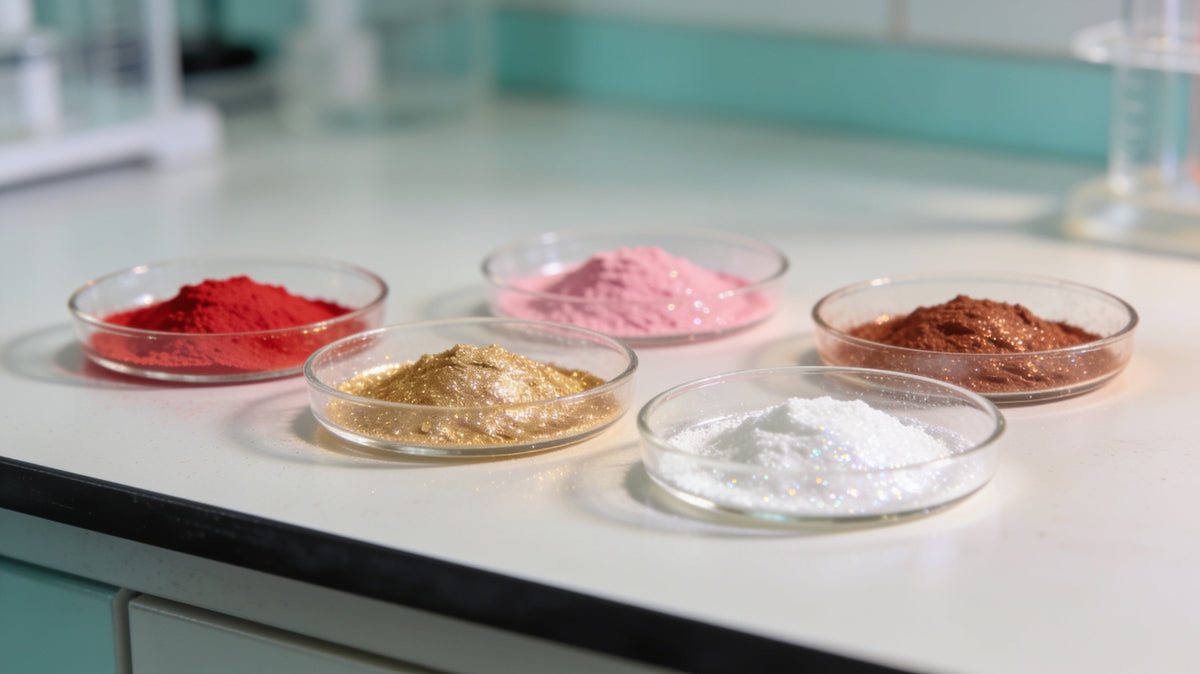
Every major market keeps its own list of permitted cosmetic colourants, often with conditions for eye, lip or mucous membrane use, so shades must be checked market by market. Lakes, mineral pigments and effect pigments behave differently in formulas. Mica needs traceable, responsible sourcing or a synthetic alternative.
Cosmetic colourants are regulated by positive lists: each market publishes which colourants are allowed, where on the body they may be used and to what purity. A shade that is compliant in one country can be non-compliant in another, so colourants should be checked against every target market before a shade is approved.
For a makeup brand, colour is the product. Yet colourant rules are the area most often left until the end of a project, when changing a pigment means re-matching and retesting a shade. This guide gives a practical, non-legal overview of how colourant rules work, the main pigment families, the documents to request, and how to approach mica sourcing. It is written for brands working with a makeup manufacturer in India and selling in India or abroad. For a definitive position on a specific product, always check the current regulation or take regulatory advice in your market.
How colourant rules work
Most markets use a positive list: if a colourant is not on the list for that use, it cannot be used. The lists usually set out:
- Identity: often by Colour Index (CI) number or a national name.
- Field of application: for example all cosmetics, not near the eyes, not on mucous membranes such as the lips, or rinse-off products only.
- Conditions: maximum levels, purity criteria and, for some materials, restrictions on particular forms.
European Union and United Kingdom
Under the EU Cosmetics Regulation, permitted colourants are listed in Annex IV, with columns indicating field of application and any conditions. The UK operates a similar framework under its own cosmetics regulation. Colourants appear on EU and UK labels by CI number. Where a colourant is used as a nanomaterial, labelling and notification rules for nanomaterials also apply.
United States
In the US, colour additives must be approved by the FDA for their intended use. Some are subject to batch certification, meaning each batch is tested and certified by the FDA before it can be used; others, many of them mineral or plant-derived, are exempt from certification but must still be approved for that use. Approval for eye-area use is specific, so a colour approved for lipstick is not automatically allowed in eyeliner. Lakes made from certifiable colours generally follow the same certification requirement as their parent colours.
India and other markets
Indian cosmetics rules refer to national standards for permitted colourants. The GCC states, ASEAN countries and many African markets have their own lists, often aligned in part with EU or US approaches but not identical. Importers should confirm the list that applies in their country.
Pigment families used in makeup
| Family | Examples | Typical use | Notes |
|---|---|---|---|
| Inorganic (mineral) pigments | Iron oxides, titanium dioxide, ultramarines, chromium oxides, manganese violet | Foundation, powders, eyeshadow, kajal | Stable, opaque, limited brightness range |
| Organic dyes and lakes | Synthetic organic colours, and lakes made by fixing a dye onto an inert substrate | Lipstick, blush, bright eyeshadow | Brighter shades; permissions vary sharply by market and body area |
| Effect pigments | Mica or synthetic substrates coated with titanium dioxide or iron oxides | Highlighter, shimmer shadows, glosses | Particle size controls sheen vs sparkle |
| Natural-origin colourants | Carmine and some plant-derived colours | Lip and cheek products | Carmine is insect-derived, so not suitable for vegan claims |
Lakes vs mineral pigments in practice
Mineral pigments are the workhorses of complexion products because they are stable and opaque, but they cannot produce every bright shade. Lakes and organic colours deliver vivid reds, pinks and purples for lips and cheeks. The trade-off is regulatory: these are the colourants most likely to be permitted for lips in one market but not for eyes in another. Our guide to eye makeup manufacturing covers the eye-area point in detail.
A note on the word "mineral": a "mineral makeup" claim should reflect the formula honestly. Many products described this way also contain non-mineral ingredients, and the word should not imply benefits the product cannot show.

Dispersion and performance
The same pigment can perform very differently depending on how it is treated and dispersed. Surface-treated pigments can improve spreadability and wear; pre-dispersions improve shade consistency. Poor dispersion causes streaks, specks and colour drift between batches. When a custom shade is developed through custom formulation, the dispersion method is part of the specification, not just the pigment list.
Mica sourcing responsibility
Natural mica provides much of the shimmer in cosmetics. Its supply chain has well-documented risks, including child labour and unsafe working conditions in some mining areas. Brands are increasingly expected by retailers and customers to show they have considered this. Practical steps:
- Ask pigment suppliers for origin and traceability information for natural mica.
- Prefer suppliers that participate in recognised responsible-sourcing programmes and can document audits.
- Consider synthetic mica (synthetic fluorphlogopite) or other synthetic substrates where traceability cannot be shown. Synthetic substrates can also give a cleaner, brighter sparkle.
- Keep the documentation on file; retail buyers and importers may ask for it.
Pigments and mica powders are available through our range, with origin information supplied on request.
Documents to request for every colourant
- Specification and certificate of analysis for each lot.
- CI number and INCI name.
- Regulatory status statement for each target market and each body area.
- Heavy metal and impurity data against the purity criteria that apply.
- For effect pigments: substrate, particle size range and origin.
- Where relevant: certification status for markets that require batch-certified colours, and nanomaterial status.
Our testing and quality team checks incoming raw materials against specification. Our facility credentials, including ISO certification, a GMP-compliant facility and US FDA facility registration, are listed on the quality certifications page. Facility registration does not approve individual colourants or products; colourant compliance is checked shade by shade.
A practical workflow for multi-market shades
- List every market you plan to sell in during the next two to three years, not just the first one.
- Define the body area for each product: lips, eyes, face or multi-use.
- Develop shades using only colourants permitted for that area in all listed markets, where possible.
- Where that is not possible, decide early whether to run market-specific versions of a shade.
- Record the colourant list for each approved shade, ready for labelling and notification.
This workflow costs a little more time at the start and saves far more later. A shade that sells well in India but cannot be shipped to the EU without reformulation is a common and avoidable problem. For labelling colourants on multi-shade products, see our guide to exporting makeup and labelling.
Frequently asked questions
What is a CI number?
A Colour Index number is an internationally used identifier for a colourant. EU and UK labels list colourants by CI number, and many other markets also use it.
Can I use the same lipstick shade in India, the EU and the US?
Often, but not always. Each market has its own list of permitted colourants and conditions. Check every colourant in the shade against each market before approval.
What is the difference between a lake and a mineral pigment?
A lake is an organic dye fixed onto an inert substrate, giving bright, insoluble colour. Mineral pigments such as iron oxides are inorganic, stable and opaque but offer a narrower colour range.
Is synthetic mica better than natural mica?
Synthetic mica avoids natural mica's supply-chain concerns and can give a cleaner sparkle. Natural mica can be used responsibly when traceability is documented.
Need pigments or custom shades? See our pigment and mica powders or talk to our private label makeup manufacturing team.
Related service: Makeup manufacturing for your brand →
Tell us your idea. An account manager replies within 1 business day.
More from Harrods Insights
Keep reading

Multilingual Labelling for Hotel Toiletries in South-East Asia: Languages, Small-Pack Layout and Halal Logo Rules

Sustainable Hotel Amenities in Singapore and South-East Asia: Refill Systems, PCR Plastic and Substantiating Green Claims