Eye Makeup Manufacturing: Eyeliner, Kajal, Mascara and Eyeshadow Safety and Claims
Eye products need extra care because permitted colourants for the eye area differ by market and are often narrower than for other areas. Mascara and liquid liners need robust preservation and suitable packaging. Claims such as ophthalmologist tested or suitable for contact lens wearers require specific evidence.
Eye makeup is manufactured to stricter expectations than most colour cosmetics: the colourants permitted around the eyes differ by market and are often narrower than for lips or face, products must be well preserved, and claims such as "ophthalmologist tested" need specific evidence held before launch.
Eyeliner, kajal, mascara, eyeshadow and brow products are strong sellers in India and across export markets. They are also the products where a careless colourant choice or weak preservation can do the most harm, both to customers and to a brand's reputation. This guide explains the main technical and regulatory points to settle with a makeup manufacturer in India before you develop an eye range.
Why the eye area is different
The skin around the eyes is thin, and products can migrate into the eye itself. Regulators reflect this. In several major markets, a colourant can be permitted in cosmetics generally but not permitted, or permitted only under conditions, for use in products applied near the eyes. The details differ:
- In the EU and UK, the list of permitted colourants indicates fields of application, including whether a colourant may be used in products applied near the eyes.
- In the US, colour additives must be specifically approved for use in the eye area; a colour approved for general cosmetic use is not automatically approved for eye products.
- Other markets, including India, the GCC and South-East Asian countries, have their own lists and conditions.
The practical rule: confirm every colourant against the eye-area rules of every market you plan to sell in, before shade approval. A shade that is legal in one market may need reformulating for another. Our guide to cosmetic pigments and colourants explains how these lists work.
Eyeliner and kajal
Liners come in several formats, each with its own base and packaging:
| Format | Notes |
|---|---|
| Kajal stick or pencil | Soft, smudgeable or long-wear; must glide on the waterline without dragging |
| Gel liner | Pot or twist-up; strong colour, needs stable texture |
| Liquid liner | Brush or felt tip; water-based formulas need robust preservation |
| Pencil liner | Wood or mechanical; lead hardness and sharpening matter |
Kajal has deep cultural roots in India. Modern cosmetic kajal is made with permitted black colourants in a cosmetic base. Traditional preparations that contain lead compounds must never be used; lead-based kohl is not an acceptable cosmetic ingredient. Black colourants used in kajal and liner should be checked for eye-area permission and purity requirements in each market. Browse examples in the eyeliner collection.

Mascara
Mascara is one of the most technical colour products. It is water-based or waterproof, applied with a brush that is returned to the tube many times, which makes contamination control critical.
- Base type: water-based (easier removal) or waterproof (resists water, needs an oil-based remover). Waterproof claims need evidence.
- Effect: lengthening, volumising and curling-look effects come from film formers, waxes, fibres and brush design together.
- Brush and wiper: bristle type, shape and wiper size change the result as much as the formula does.
- Preservation: preservative efficacy testing in the final packaging is essential.
- Period after opening: mascaras are usually given a short period after opening because of repeated contact with lashes and eyes.
Our mascara bottles and components page shows available packaging.
Eyeshadow
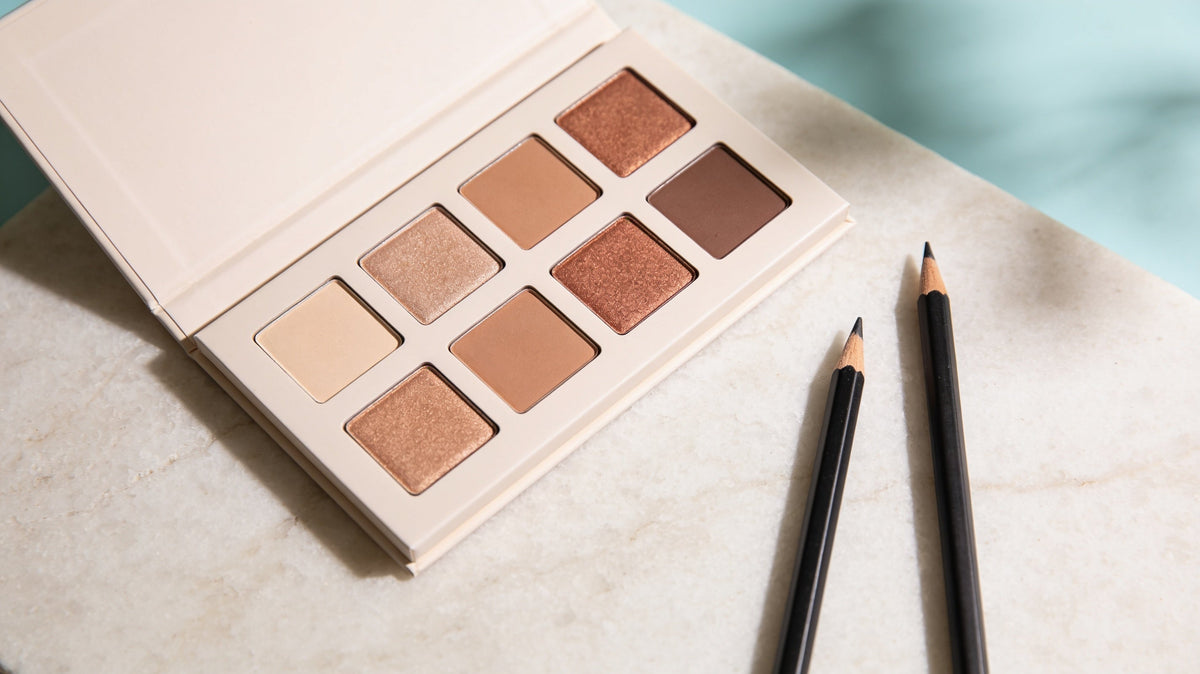
Eyeshadows are pressed or loose powders, creams, sticks or liquids. They share technology with face powders but carry eye-area colourant restrictions. Shimmer and glitter materials must be permitted for eye use and should be checked for particle size and shape. Fallout, where particles drop onto the cheeks or into the eye, is both a quality and a comfort issue. Palette packaging must protect pans in transit. Matte, satin and metallic finishes can sit together in one palette if each is tested for payoff and blendability.
Brow products
Brow pencils, gels, pomades and powders sit close to the eye and should be treated with the same colourant care. Tinted brow gels with fibres need the same preservation and packaging attention as mascara.
Claims that need evidence
Eye products attract some of the most specific claims in makeup. Each needs evidence held before the claim is made:
- "Ophthalmologist tested": requires a study conducted under the supervision of an eye specialist, typically an in-use study on a panel of users. It describes how the product was tested, not a guarantee.
- "Suitable for contact lens wearers" and "suitable for sensitive eyes": require a study on users from that group.
- "Waterproof", "smudge-proof" and wear times: require wear studies under defined conditions. See our guide to long-wear and waterproof claims.
- Lash "growth" claims: claims that a product makes lashes grow are physiological and can take a product outside cosmetic rules. Stick to appearance, such as "longer-looking lashes".
Formulas can be supplied as dermatologically tested, with test reports on request. Dermatological testing is not the same as ophthalmological testing; do not substitute one for the other in claims.
Packaging for eye products
Packaging for eye products has a direct effect on hygiene and performance, so choose it alongside the formula rather than after it.
- Mascara components: the bottle, wiper and brush must work together. A wiper that is too loose leaves clumps on the brush; one that is too tight starves the lashes of product.
- Liquid liner pens: felt or brush tips need a formula with the right flow; a mismatch causes skipping or flooding.
- Pencils: wooden pencils need a lead that sharpens cleanly; mechanical twist-up pencils avoid sharpening but need a compatible lead diameter.
- Palettes: pans should be secure and the closure firm, with a mirror if your customers expect one.
Airless or sealed designs reduce contamination for some formats. Whatever the choice, run stability and compatibility testing in the final component, because changing a brush or wiper later can change both the result and the preservation performance. Our custom packaging team supplies mascara and eye packaging and can advise on fit.
Quality and microbiology
For eye products, batch release typically covers appearance, shade against standard, viscosity or hardness, fill weight and microbiological quality. Stability and compatibility testing in the final packaging should include preservation performance over the intended shelf life and period after opening.
Starting an eye range
- List your target markets first, then filter shades by eye-area colourant permission.
- Choose formats and packaging together, especially for mascara and liquid liner.
- Decide which claims matter and budget for the studies behind them.
- Request samples and wear them in real conditions, including humidity and heat.
Ready formulas start from 500 units per product; ask for shade MOQs for custom colours.
Frequently asked questions
Are eyeshadow colourants the same as lipstick colourants?
Not necessarily. Several markets restrict which colourants can be used near the eyes, and those lists differ from lip rules. Check each colourant for eye-area use in every target market.
Can I call my kajal ophthalmologist tested?
Only if it has been tested in a study conducted under the supervision of an eye specialist and you hold the report. Dermatological testing alone does not support that claim.
Why do mascaras have a short period after opening?
The brush returns to the tube after contact with lashes many times, which increases contamination risk. Robust preservation and a short period after opening help protect users.
Is traditional kohl safe to sell?
Preparations containing lead compounds must not be used. Modern cosmetic kajal is made with permitted black colourants in a cosmetic base, checked against each market's eye-area rules.
Explore the eye makeup range or plan your eye collection with our private label makeup manufacturing team.
Related service: Makeup manufacturing for your brand →
Tell us your idea. An account manager replies within 1 business day.
More from Harrods Insights
Keep reading

Reef-Friendly and Ocean-Conscious Hotel Amenities: What the Claims Mean and How to Judge Them

Ayurveda and Wellness Spa Amenities for Sri Lankan Hotels: Massage Oils, Herbal Body Care and Claims