
Miniatures vs Wall Dispensers vs Bulk Refills: Choosing a Hotel Toiletries Format

Miniatures feel personal but generate the most packaging; dispensers and bulk refills reduce waste and deliveries but need a disciplined refilling routine. Most properties mix formats by room category and area.
Miniatures suit properties where a personal, gift-like amenity matters most; wall or countertop dispensers with 5 L bulk refills suit properties prioritising lower packaging waste and simpler replenishment. Many hotels combine both, using dispensers in standard rooms and minis or sachets where guests expect a take-home touch.
Choosing a toiletry format is not only a sustainability decision or only a cost decision. It shapes how guests perceive the room, how long housekeeping spends in each bathroom, how much storage you need, and how much plastic leaves the property. As a hotel amenities manufacturer in India, Harrods Health produces the same formulas in 30 ml and 40 ml minis, sachets, 300 ml dispenser bottles and 5 L refills, so the format choice can be made on operational grounds rather than product availability.
The four main formats
Miniatures (30 ml / 40 ml)
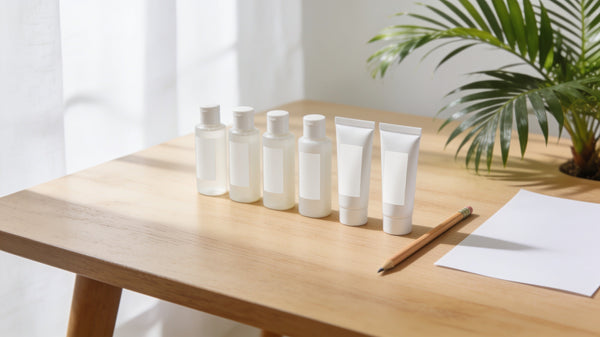
Small bottles or tubes placed per stay. They feel personal, are easy to brand, and guests often take them home, which extends brand visibility. The trade-off is packaging: every mini is a bottle, a cap and a label, and partly used minis are typically discarded at checkout.
Sachets
Single-use portions in printed film. Compact, light to ship and useful for budget rooms, travel kits, airline lounges or as a backup in rooms that otherwise use dispensers. Guests may see them as functional rather than premium. See our sachets and gift sets page for options.
300 ml dispenser bottles
Pump bottles fixed to a wall bracket or placed on the counter. They serve many stays, reduce packaging per guest and can look premium when the bottle and decoration are chosen carefully. Browse pump packaging for styles.
5 L bulk refills
Large containers used by housekeeping to supply dispensers, or connected to closed cartridge systems. They cut deliveries, storage of small items and packaging volume. Hygiene depends entirely on the refilling routine, covered in our refilling SOP for bulk refills and dispensers. Bulk options are listed under bulk packs.
Side-by-side comparison
| Factor | Miniatures | Sachets | Dispensers + refills |
|---|---|---|---|
| Guest perception | Personal, gift-like | Functional | Modern; premium if well designed |
| Packaging per stay | Highest | Low weight, but not usually recyclable | Lowest |
| Housekeeping task | Replace per stay | Replace per stay | Check level, refill or swap on a schedule |
| Wastage of product | Partly used minis discarded | Low | Low, if refilled correctly |
| Storage | Many small cartons | Compact | Fewer, larger containers |
| Brand visibility | High, travels home | Moderate | High in room, does not travel |
| Regulatory exposure | Restricted in some jurisdictions | Check local rules | Generally favoured |

Cost drivers per room night
Rather than comparing unit prices, compare what you spend to supply one occupied room for one night. The drivers differ by format:
- Packaging share. In minis, the bottle, cap, label and carton form a large part of each unit's cost. In refills, packaging is spread over many uses.
- Discarded product. Minis opened but not finished are usually thrown away. Dispensers keep unused product in service.
- Labour. Placing minis is quick but happens every stay. Refilling takes longer per visit but happens less often.
- Freight and storage. Concentrated volume in 5 L containers usually moves and stores more efficiently than thousands of small units.
- Pilferage and over-use. Guests take minis; dispensers can be removed if brackets are weak. Choose secure fittings.
- Branding. Printed minis need a print run per design; dispensers can carry a smaller number of higher-quality decorated bottles.
Ask your manufacturer to quote each format on the same formula so the comparison is fair, then model it against your own occupancy and housekeeping times.
Guest perception: what actually matters
Guests judge amenities on a few signals: the scent when they first open the cap or press the pump, how the product feels on skin and hair, how clean and full the dispenser looks, and whether the pack looks considered. A dispenser that is sticky, half-empty or mismatched with the décor undermines the room. A well-designed, sealed or clearly maintained dispenser can feel as premium as a mini.
Transparency helps. A small card explaining that the property uses refillable dispensers to reduce plastic usually lands well, as long as the dispensers look cared for.
Waste and sustainability
Several jurisdictions now restrict small single-use plastic toiletry bottles in lodging, and many corporate travel buyers ask about plastic reduction. Dispensers and bulk refills are the most direct way to cut packaging volume. If you keep minis, consider post-consumer recycled plastic, aluminium or refill-friendly sizes. Our guide to single-use plastic rules for hotel amenities covers the regulatory picture.
Think too about what happens at the end of each format's life. Small minis with pumps, mixed materials or shrink sleeves are hard to recycle. Larger dispenser bottles can be washed and reused for a long period, and empty 5 L containers can often be returned, reused for non-cosmetic purposes on site, or collected by a recycler. Ask your supplier which components are mono-material and which carry recycled content, and make sure your waste contractor can actually process them locally.
Mixing formats by area
Few properties use a single format everywhere. A practical mix might look like this:
- Standard rooms: 300 ml dispensers for shampoo, conditioner or 2-in-1, and body wash; lotion in a mini or dispenser.
- Suites and premium rooms: decorated dispensers plus a take-home mini set.
- Gyms, pools and spa showers: dispensers fed from 5 L refills, often 2-in-1 hair and body wash.
- Public washrooms and lounges: hand wash dispensers on refills.
- Travel kits and amenity requests: sachets or minis held at the front desk.
Using the same formula and scent across all formats keeps the guest experience consistent wherever they encounter the brand.
Practical points for dispensers
If you move to dispensers, a few details decide whether guests notice the change positively:
- Viscosity and pump match. The formula must flow cleanly through the pump without dripping or clogging. Test the exact pump and bottle with the exact formula.
- Clear identification. Shampoo, conditioner and body wash bottles should be easy to tell apart in a steamy shower, through print, colour or icons.
- Secure fixing. Lockable brackets or tamper-evident designs reduce removal and interference.
- Level visibility. Housekeeping should be able to see the fill level quickly without opening the bottle.
- Batch labelling. Each refilled or replaced bottle should be traceable to the refill batch it came from.
How to decide
- List your room categories and shared areas.
- Note local rules on small plastic bottles.
- Estimate housekeeping time per format with your executive housekeeper.
- Request samples of each format on the same formula.
- Trial in a few rooms and gather guest and staff feedback before rolling out.
Frequently asked questions
Are dispensers cheaper than miniatures for hotels?
Often, per room night, because packaging is spread over many uses and less product is discarded. The real answer depends on your occupancy, labour costs, dispenser hardware and how well refilling is managed, so model both on the same formula.
Do guests see wall dispensers as less premium?
Not when the bottle is well designed, clean and visibly maintained. Problems arise when dispensers look sticky, empty or mismatched with the room.
Can the same formula be supplied in minis, sachets, dispensers and 5 L refills?
Yes. The hotel range is produced in 30 ml and 40 ml minis, sachets, 300 ml dispenser bottles and 5 L refills, so scent and texture stay consistent across formats.
Which format works best for gyms and pool showers?
Dispensers fed from 5 L refills, often with a 2-in-1 hair and body wash, are a common choice for high-traffic shared showers.
Compare formats on your own formula: visit our hotel toiletries manufacturing page to request samples.
Related service: Hotel amenities manufacturing for your property →
Tell us your idea. An account manager replies within 1 business day.
More from Harrods Insights
Keep reading
Multilingual Labelling for Hotel Toiletries in South-East Asia: Languages, Small-Pack Layout and Halal Logo Rules

Sustainable Hotel Amenities in Singapore and South-East Asia: Refill Systems, PCR Plastic and Substantiating Green Claims