Reef-Friendly and Ocean-Conscious Hotel Amenities: What the Claims Mean and How to Judge Them
Reef-friendly and ocean-conscious have no single legal definition in many markets, so the label alone proves little. Ask suppliers for the ingredient list, a written definition and test evidence, and use specific, documented statements with guests instead of broad labels.
"Reef-friendly" and "ocean-conscious" have no single legal definition in many markets, so the words alone tell a resort very little. Treat them as claims that need evidence: ask what was tested, against which standard, and what the claim covers, and prefer specific, factual statements over broad labels.
Resorts in the Maldives and on Sri Lanka's coasts sell the sea. Understandably, many want amenities that do not undermine that. This guide explains what these claims tend to mean, how to avoid misleading guests and how to judge a supplier's claims. For our regional overview, see the Maldives and Sri Lanka hotel amenities hub.
A note before we start: Harrods Health does not describe its products as reef-safe or reef-friendly. This guide is about how to evaluate such claims, not a claim about our range.
Where the claims come from
Reef-related claims grew mainly from concern about certain sunscreen filters, and some jurisdictions have restricted particular sunscreen ingredients. Over time the language spread to other products, including shampoo, shower gel and body wash, often without the same scientific basis. A shower gel goes down a drain, not straight into a lagoon, although on some islands treated wastewater may eventually reach the sea.
Because there is often no agreed legal meaning, two products with the same label can mean quite different things. One may simply exclude a short list of ingredients; another may have been tested for biodegradability or aquatic toxicity. A third may have no evidence at all.
What a claim might actually mean
| Wording you might see | What it could mean | What to ask for |
|---|---|---|
| Reef-friendly / reef-safe | Excludes certain ingredients; sometimes nothing specific | The exclusion list and any test data |
| Ocean-conscious | A general intention, sometimes about packaging | What exactly is different, and the evidence |
| Biodegradable | The formula, or a part of it, breaks down under test conditions | Test method, which components were tested, results |
| Free from [ingredient] | The named ingredient is not in the formula | Full ingredient list to confirm |
| Microplastic-free | No solid plastic particles added | Ingredient list and the supplier's definition |

Why misleading claims are a risk
Environmental claims attract growing attention from regulators and consumer groups in many markets, and from guests who know the subject. A broad claim that cannot be supported can damage trust in the resort's wider sustainability work. If your guests come from markets with strict advertising rules, your marketing may be judged by those standards too.
The safest approach is to say exactly what you do and nothing more. "Our bathroom liquids are rinse-off formulas free from added microplastics" is easier to defend than "reef-safe amenities", provided it is true and documented.
Formulation choices for rinse-off products
Shampoo, conditioner, shower gel, 2-in-1 and hand wash are rinse-off products, so most of what goes on the skin goes down the drain. Resorts that want to reduce their footprint often discuss the following with their manufacturer:
Ingredients
- Avoiding added solid plastic particles such as exfoliating beads
- Asking which surfactants are used and whether biodegradability data exists for them
- Keeping fragrance and colour levels moderate
- Reviewing preservatives with the manufacturer, balancing safety in a warm, humid climate against environmental concerns
Format and quantity
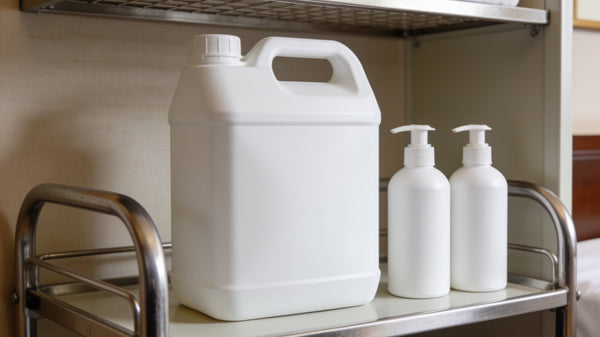
- Using dispensers filled from 5 L refills to cut small-bottle waste
- Choosing pump sizes that deliver a sensible dose
- Training housekeeping not to discard part-used product unnecessarily
What about leave-on products?
Body lotion stays on the skin and may come off in the sea or pool. Sunscreen is where most reef concerns have focused, and Harrods Health does not make sunscreen. If your resort sells or provides sunscreen, take advice on the ingredient restrictions that apply in your market and your guests' home markets.
Our article on reducing single-use plastic in hotel amenities covers the packaging side in more depth.
How to evaluate a supplier's claim
Whether you are reviewing us or any other manufacturer, a structured set of questions works better than accepting a label at face value.
- Ask for the full ingredient list. Every claim should be checkable against it.
- Ask what the claim means. Request a written definition: which ingredients are excluded, which tests were run.
- Ask for the evidence. Test reports should name the method, the laboratory and what was tested, whether the full formula or one ingredient.
- Check the scope. A claim about one ingredient does not cover the whole product, and a claim about the formula does not cover the packaging.
- Check consistency. The claim on the label, the website and the spa menu should match.
- Ask about change control. If the formula changes, how will you be told, and will the claim still hold?
- Check general credentials. Manufacturing licences, quality certification and Halal status tell you about the facility, even though they say nothing about reef impact.
Our certifications are listed on our quality and certifications page. Formulas can be supplied as dermatologically tested, with test reports on request. Neither is a reef or environmental claim.
Writing honest guest communication
Guests respond well to clear, modest statements. Some examples, to use only when they are true for your property:
- "We use refillable dispensers in every villa to reduce single-use bottles."
- "Our bathroom liquids contain no added microplastics."
- "We have reduced the number of small amenity bottles shipped to the island."
Avoid statements that imply your amenities protect or benefit the reef, unless you hold strong, relevant evidence. Keep the documents behind each statement on file.
Packaging is part of the picture
Many guests read "ocean-conscious" as a statement about plastic as much as about formulas. Moving from minis and sachets to dispenser bottles filled from 5 L refills is often the change that guests notice most, and it is easier to measure than a formula's effect on the sea. Record how many small containers you buy before and after the switch, and you have a claim you can back up. You can compare formats in our hotel amenities range.
Remember that waste leaving an island also travels by boat. Fewer containers mean fewer sacks to sort, store and ship, which is a practical benefit whether or not you mention it to guests.
Bringing it together for island and coastal resorts
The Maldives and Sri Lanka differ in supply chains and property types, but the logic of claims is the same. See our Maldives and Sri Lanka pages for market detail, and our hotel toiletries page for formats.
Frequently asked questions
Is there a legal definition of reef-safe?
In many markets there is no single legal definition, although some jurisdictions restrict specific sunscreen ingredients. Ask any supplier exactly what their claim means and what evidence supports it.
Are your hotel toiletries reef-safe?
We do not make reef-safe or reef-friendly claims for our products. We can share full ingredient lists so your team can review them, and formulas can be supplied as dermatologically tested with test reports on request.
Does biodegradable mean safe for the ocean?
Not necessarily. Biodegradability describes how a substance breaks down under test conditions. It does not on its own show that a product has no effect on marine life.
What is the most defensible environmental claim for amenities?
A specific, factual one you can document, such as switching villas to refillable dispensers or removing added microplastics, rather than a broad label such as "ocean-friendly".
Reviewing your amenity claims? Start at our Maldives and Sri Lanka hub and ask us for ingredient lists and samples.
Related service: Hotel amenities supplier for the Maldives and Sri Lanka →
Tell us your idea. An account manager replies within 1 business day.