How to Start a Pet Grooming Brand in India: The Manufacturing Checklist
Published by Harrods Health Private Limited, a private label and contract manufacturer in Ambala, Haryana, India. By Hemang Jain, Founder, Anadoris.
To start a pet grooming brand in India, define your customer, pick three to six launch products and choose a manufacturer that makes pet-specific formulas. Most brands launch fastest with ready formulas, then add custom work once they know what sells.
To start a pet grooming brand in India, you need a clear product range, a manufacturer that can make pet-specific formulas at a sensible minimum order, compliant labels, and a plan for packing and dispatch. Most new brands launch fastest with ready formulas, then move to custom work once they know what sells.
The pet grooming category rewards brands that are organised. Owners want products that are gentle, smell pleasant and do what the label says, and retailers want reliable supply. This checklist walks through the manufacturing side of a launch, step by step, so you can brief a partner with confidence. If you are already comparing partners, our page on pet care third-party manufacturing explains how we work with pet brands, shops, groomers and importers.
Step 1: Decide who you are selling to
Before you choose a single formula, be precise about the customer. The same shampoo can be positioned very differently depending on the channel.
- Pet parents buying online: they read reviews, compare scents and respond to clear, simple claims such as "gentle everyday cleansing" or "leaves the coat soft".
- Pet shops and pet supermarkets: they want a tidy range, good shelf presence and margins that work at their price points.
- Professional groomers: they care about dilution, rinse-out time, lather and larger pack sizes.
- Vets' retail counters: they expect conservative claims, clear ingredient lists and products that sit comfortably alongside clinical advice.
- Importers and distributors abroad: they need documents, export-ready labelling and consistent batches.
Write one sentence describing your main customer. It will shape pack sizes, fragrance choices and how much you spend on packaging.
Step 2: Build a focused launch range
A common mistake is launching with too many products. Three to six well-chosen items usually beat fifteen thin ones, because each product needs stock, photography, listings and reviews.
Typical starter ranges
- Core bath: a pet shampoo and a matching conditioner.
- Between-bath care: a deodorising or cologne spray, a detangling spray, or a waterless shampoo.
- Care add-ons: a paw and nose butter, a coat oil or an ear cleanser.
- Home: hygiene products for bedding, floors and litter areas.
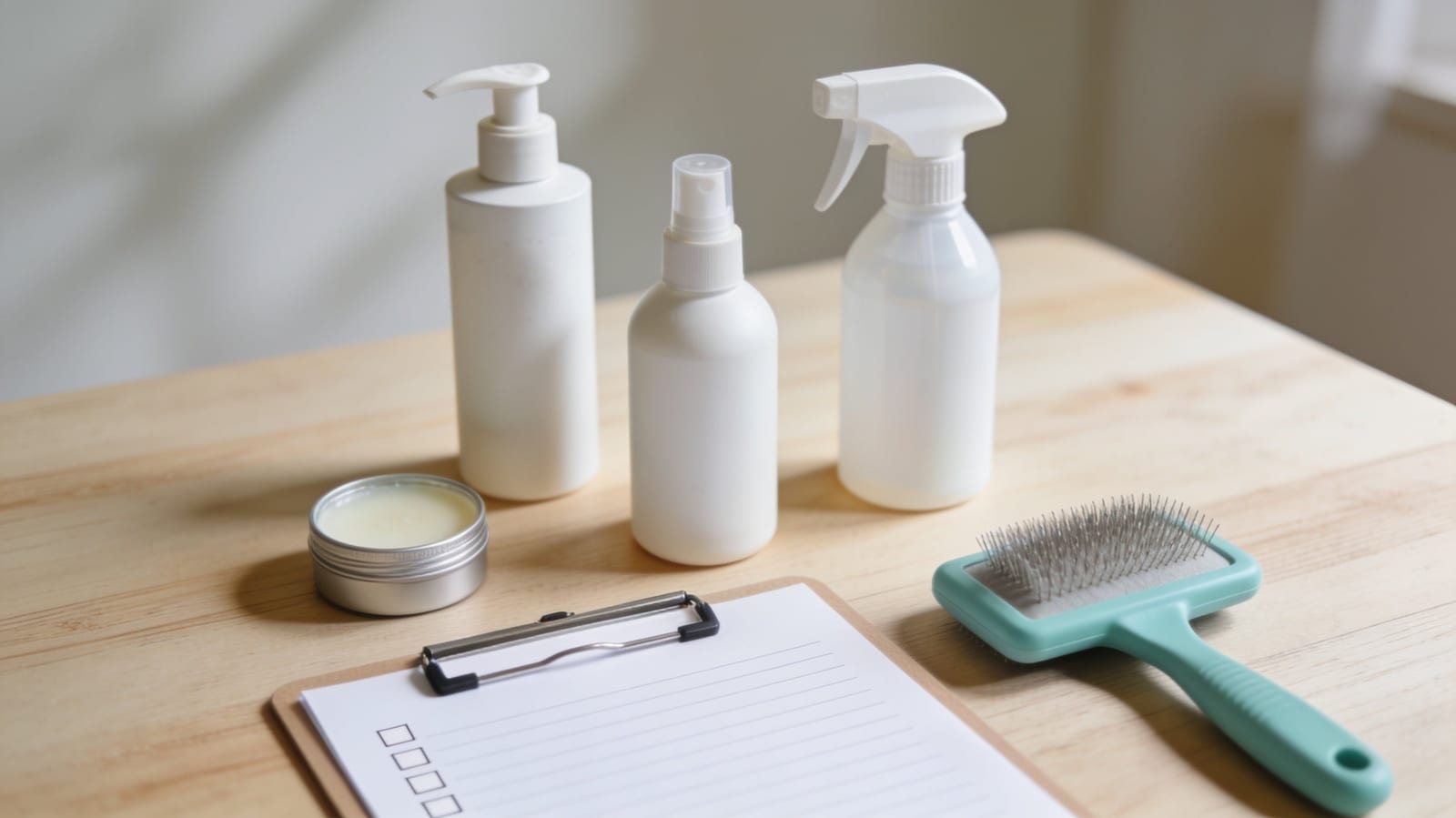
Shampoo plus spray plus balm is a sensible first trio for many brands: it covers bath day, the days in between and a care moment owners enjoy. You can browse the full span of formats across our pet care range.
Step 3: Choose ready formula or custom formula
This is the biggest decision on the manufacturing side, and it affects cost, speed and how distinctive your product feels.
| Factor | Ready formula (private label) | Custom formula |
|---|---|---|
| Speed to market | Faster, as the base is already developed | Slower, because development and testing come first |
| Minimum order | Lower; confirmed on enquiry | Usually higher, depending on the brief |
| Upfront cost | Lower | Higher, with development and trial batches |
| Distinctiveness | Achieved through fragrance, colour, name and packaging | Achieved through the formula itself as well |
| Best for | New brands, shops, groomers testing demand | Established brands with a clear gap to fill |
With ready formulas you can still choose a custom fragrance, colour and packaging, so the product does not have to feel generic. We cover the trade-offs in more depth in private label vs custom formula for pet brands.
Step 4: Get the formula basics right for animals
Pet grooming products are not simply human products in a different bottle. A good manufacturer will design around a few animal-specific realities:
- Skin pH: dog and cat skin is generally less acidic than human skin, so cleansing systems are balanced differently. Our guide to pH for dog and cat shampoos explains why.
- Licking and grooming: animals lick their coats and paws, so anything left on the skin, such as balms and sprays, should be formulated with that in mind. Xylitol, for example, has no place in anything a dog might lick.
- Species differences: cats are more sensitive than dogs to many essential oils and phenol-type ingredients. A product labelled for cats needs its own, more cautious formula.
- Fragrance strength: animals have a far keener sense of smell than people. Lighter fragrance levels are usually kinder and still read as "fresh" to the owner.
Step 5: Decide on claims early
Claims decide which regulations apply to you, so settle them before artwork. A grooming product cleanses, conditions, freshens, detangles and helps the coat look and feel better. Once a label promises to kill parasites or treat a skin condition, the product moves into insecticide or veterinary medicine territory, with separate registrations. Keeping to cosmetic grooming language is the simplest route for a new brand. Our separate guide on labelling covers this in detail; for any borderline wording, speak to a regulatory adviser before printing.
Step 6: Plan packaging and branding
Packaging is where most of your brand identity lives, especially with ready formulas. Consider:
- Format: bottles with flip-top caps for shampoos, trigger or fine-mist sprayers for sprays, tins or twist-up sticks for balms.
- Size: retail sizes for pet parents, larger sizes for groomers.
- Material and finish: wet-hand grip, drop resistance and how the label survives a damp bathroom.
- Decoration: printed labels, sleeves or direct print, plus cartons if you want a premium feel.
Our custom packaging page explains the options.
Step 7: Budget for the right things
Costs come from a handful of drivers rather than a single number. Expect the per-unit price to depend on:
- The formula and its ingredient quality.
- Pack size and packaging components.
- Decoration method and number of colours.
- Order quantity, since larger runs spread set-up costs.
- Fragrance choice, especially if it is custom.
- Secondary packing, cartons and shipping preparation.
Our MOQ and pricing page sets out how minimum order quantities work.
Step 8: Sample, approve, then order
Never skip sampling. Ask for samples of the shortlisted formulas, then test them the way your customers will: bathe a few dogs or cats of different coat types (with owners' consent), check lather, rinse, smell after drying and how the coat feels a day later. Approve the fragrance and colour in writing, and sign off final artwork against a printed proof.
Step 9: Check the manufacturer's credentials
Ask what licences and certifications the facility holds and request copies. Our facility holds GMP (cosmetics), ISO 9001, ISO 22716 and ISO 14001. You can read more on our quality certifications page. Formulas can also be supplied as dermatologically tested, with test reports available on request.
Step 10: Plan dispatch before production ends
Know where the goods are going before the last unit is filled. Will stock go to your own warehouse, a marketplace fulfilment centre, a distributor or an export port? Each destination has its own packing, labelling and paperwork expectations. We handle packing, documents and dispatch to warehouses, marketplaces or export ports, and you can see how on our fulfilment and export page.
The launch checklist at a glance
- Customer and channel defined in one sentence.
- Three to six launch products chosen.
- Ready or custom formula route decided.
- Species, pH and licking considerations covered.
- Claims kept to cosmetic grooming language.
- Packaging, sizes and decoration chosen.
- Cost drivers understood and MOQ agreed.
- Samples tested and approved in writing.
- Manufacturer licences and certificates checked.
- Dispatch destination and documents arranged.
Frequently asked questions
How many products should a new pet grooming brand launch with?
Most new brands do well with three to six products. A shampoo, a spray and a balm cover the main grooming moments without tying up too much cash in stock.
Can I launch a pet brand without developing my own formula?
Yes. Ready formulas let you launch, with your own fragrance, colour, name and packaging, so the product still feels like your brand.
Do I need separate products for cats and dogs?
For anything left on the coat, it is wise to. Cats are more sensitive than dogs to many essential oils and phenol-type ingredients, so cat products need a more cautious formula.
Will the manufacturer help with export shipments?
We handle packing, documents and dispatch to warehouses, marketplaces or export ports, and a single account manager coordinates the order from sampling to dispatch.
Ready to plan your range? Start with our pet care manufacturing services and request samples.
Related service: Pet grooming third-party manufacturing →
Tell us your idea. An account manager replies within 1 business day.
More from Harrods Insights