Multilingual Labelling for Hotel Toiletries in South-East Asia: Languages, Small-Pack Layout and Halal Logo Rules
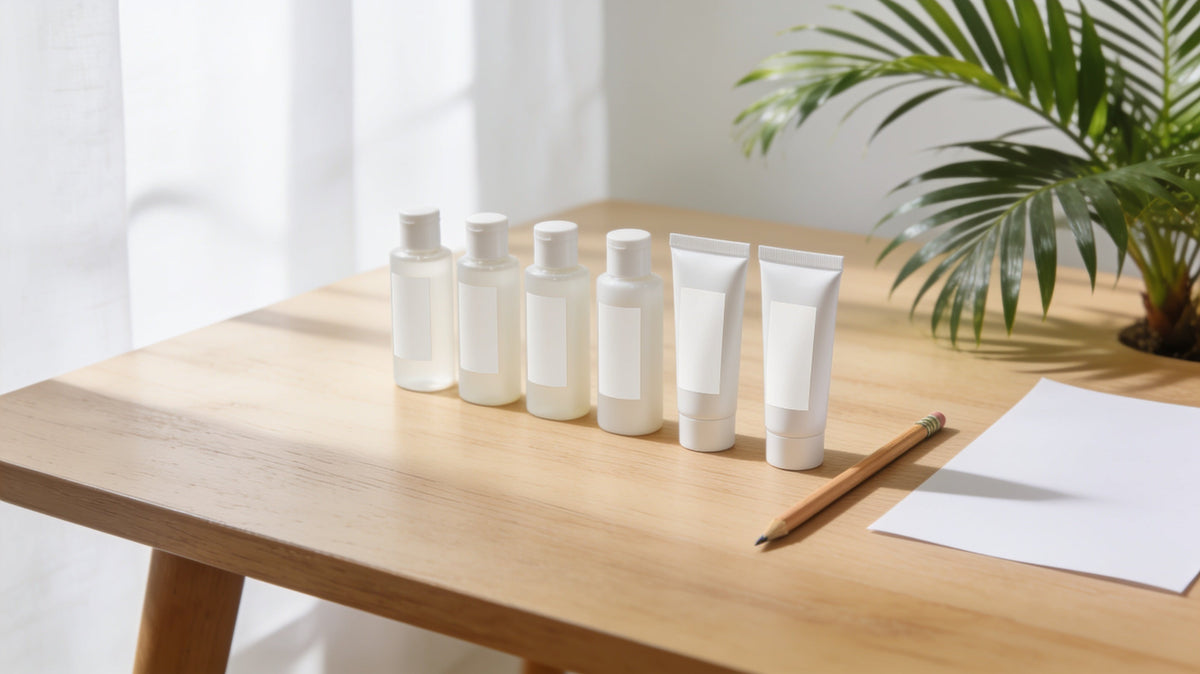
Each market expects the cosmetic particulars in its required language, so plan Thai, Bahasa Indonesia and Vietnamese text alongside English. Lay out small packs with a clear hierarchy, get the notification holder's approval before printing, and use a halal logo only under a valid certificate.
Hotel toiletries for South-East Asia must carry the mandatory cosmetic particulars in the language each market requires: typically Thai in Thailand, Bahasa Indonesia in Indonesia, Vietnamese in Vietnam and English or the national language elsewhere. Small packs need careful layout, and a halal logo may appear only when a valid certificate covers that product.
A label on a 30 ml bottle has to do several jobs: carry the hotel's brand, tell the guest what is inside and satisfy a regulator who may inspect it. Across a region with half a dozen languages and scripts, that takes planning. This guide sets out the requirements most procurement teams meet, the layout choices that work on small packs and the mistakes that cause relabelling. It is a planning guide; confirm current rules with your importer or a local regulatory consultant, and brief your hotel amenities supplier for South-East Asian hotels early.
What a cosmetic label must show
The ASEAN Cosmetic Directive sets common labelling requirements. In broad terms, the label should show:
- the product name and, unless obvious, its function;
- directions for use, where needed;
- the full ingredient list using INCI names;
- the country of manufacture;
- the name and address of the company responsible for placing the product on the local market;
- the net contents by weight or volume;
- the batch number;
- the manufacture or expiry date, as the market requires;
- special precautions, such as warnings for certain ingredients;
- the notification number, where the country requires it on the label.
Some particulars may go on the outer pack, a leaflet or a tag where the container is too small, but the rules on which ones vary. For the regulatory background, see our guide to ASEAN cosmetic notification for hotel toiletries.
Languages by market
| Market | Language commonly expected | Practical approach |
|---|---|---|
| Thailand | Thai | Thai text printed or on a supplementary label; see Thailand |
| Malaysia | Bahasa Malaysia or English | English is widely used; confirm with the notification holder |
| Singapore | English | English label |
| Indonesia | Bahasa Indonesia | Indonesian text required; see Indonesia |
| Vietnam | Vietnamese | Often a Vietnamese supplementary label; see Vietnam |
| Philippines | English | English label; see Philippines |
INCI ingredient names are standardised and generally do not need translation. Product names, directions and warnings do.

Small-pack layout
Minis, tubes and sachets leave little room. A clear hierarchy keeps the brand intact and the label compliant.
Front panel
- Hotel logo or brand mark.
- Product name and function in the main language, for example "Shampoo" in English and Thai.
- Net contents.
Back panel or wrap
- Ingredients (INCI) in a legible type size.
- Directions and warnings in the required languages.
- Responsible company, country of manufacture, batch and date.
Space-saving techniques
- Icons with words: pictograms help guests but should support, not replace, required text.
- Multi-language blocks that share one ingredient list.
- Peel-back or extended labels on minis where the rules require more text.
- Outer packaging for particulars permitted there, where minis ship in cartons that reach the guest.
- Separate print runs per country when volumes justify them.
Harrods Health prints hotel branding on minis, tubes, sachets, dispenser bottles and 5 L refills and can lay out multilingual text with your notification holder's approved wording. See our hotel toiletries formats.
Dispensers and refills
Wall-mounted and countertop dispensers still need to identify the product. The 5 L refill carries the full label; the dispenser carries the product name and brand, with the remaining particulars available to guests in a way agreed with the local responsible company. Record the refill batch when decanting so the product remains traceable.
Halal logos on labels
Halal matters to guests and buyers in Malaysia and Indonesia and to many properties across the region. The rules for printing a logo are strict:
- Only with a valid certificate covering that specific product and site.
- Only the logo the certifying body permits, used as its rules allow.
- Recognition matters: some markets expect certification from bodies recognised by the national halal authority, such as JAKIM in Malaysia, MUIS in Singapore or BPJPH in Indonesia. A certificate valid in one country is not automatically recognised in another.
- Keep certificates current and do not print a logo on stock that may outlive the certificate.
Harrods Health is Halal certified. Our halal hotel toiletries certification guide explains recognition in more depth.
Common mistakes
- Printing before the notification holder approves the wording. Get sign-off on every language first.
- Machine translation of directions and warnings. Use a qualified translator and a native-speaker check.
- Script rendering errors. Thai and Vietnamese diacritics can break in artwork software; proof at full size.
- Ingredient list mismatch after a fragrance or preservative change.
- Illegible type on minis because too many languages were squeezed onto one panel.
- Claims that differ by language, where a translated claim says more than the English.
- Stickers that peel in humid bathrooms; specify water-resistant materials.
- Halal logos without coverage for the specific product.
Brand space versus regulatory space
Designers often want the hotel's identity to fill the pack. Regulators want the particulars legible. Both can be met if the label is planned in zones from the start:
- Brand zone: logo, product name and a short sensory descriptor, kept consistent across every market.
- Regulatory zone: ingredients, directions, warnings, responsible company, batch and date, set in a fixed grid that can be swapped by language.
- Variable zone: notification number, local importer details and halal mark where applicable.
A fixed grid lets the same base design run across six markets with only the regulatory and variable zones changing. It also makes approvals quicker, because the local responsible company reviews a familiar layout each time.
Retail and spa products
Products sold to guests, such as retail-size shower gel or massage oil, usually need full consumer labelling on the container in the local language. Do not assume the in-room approach carries over to retail.
A workable artwork process
- Agree the master English text and INCI list with the manufacturer.
- Send it to the local responsible company in each market for wording and translation.
- Lay out the multilingual artwork and proof physically on the actual pack.
- Obtain written approval before printing.
- Archive approved artwork with the product information file.
Frequently asked questions
Can one label serve all South-East Asian markets?
Rarely in full. English works in Singapore, Malaysia and the Philippines, but Thailand, Indonesia and Vietnam expect their national language. Many groups use a core English label with country-specific stickers or separate print runs.
Is a supplementary sticker acceptable instead of printing the local language?
In several markets a local-language sticker applied before sale is accepted. Confirm with the importer or local responsible company, and make sure the sticker is durable in humid bathrooms.
Can we print a halal logo if our manufacturer is halal certified?
Only if the specific products are covered by a valid certificate and the logo is used as the certifying body allows. Some markets expect logos from bodies they recognise. Check before printing.
What if a 30 ml bottle is too small for all the information?
Prioritise the particulars that must be on the container itself, use the outer pack or other permitted means for the rest where the rules allow, and agree the approach with the local responsible company before printing.
Need multilingual artwork for a regional rollout? Talk to us about hotel amenities for South-East Asian hotels.
Related service: Hotel amenities supplier for South-East Asian hotels →
Tell us your idea. An account manager replies within 1 business day.
More from Harrods Insights
Keep reading

Sustainable Hotel Amenities in Singapore and South-East Asia: Refill Systems, PCR Plastic and Substantiating Green Claims
Private-Pool Villa Amenities: Premium Formats, Refillable Glass and Ceramic, In-Villa Retail and Humidity-Proof Packaging